Carbon is the currency of nature: the backbone of soil organic matter and the energy source for soil microorganisms. Therefore, much interest in soil health focuses on increasing carbon storage in soil. When you reduce tillage or increase crop rotation diversity, you expect soil organic matter to increase. However, soil organic matter often changes slowly for several years. In fact, less than 1% of plant biomass carbon returned to soil eventually becomes stable humus organic carbon.
Active carbon, also known as permanganate-oxidizable carbon (POXC), is a sensitive tool for measuring soil carbon change. This portion of soil organic matter is actively involved in nutrient cycling and changes more quickly when cropping systems are changed (e.g. reduced tillage, diversified crop rotation, cover crop inclusion). Active carbon is a quick, repeatable soil test that measures the easily oxidizable, biologically active carbon fraction.
Why is active carbon important?
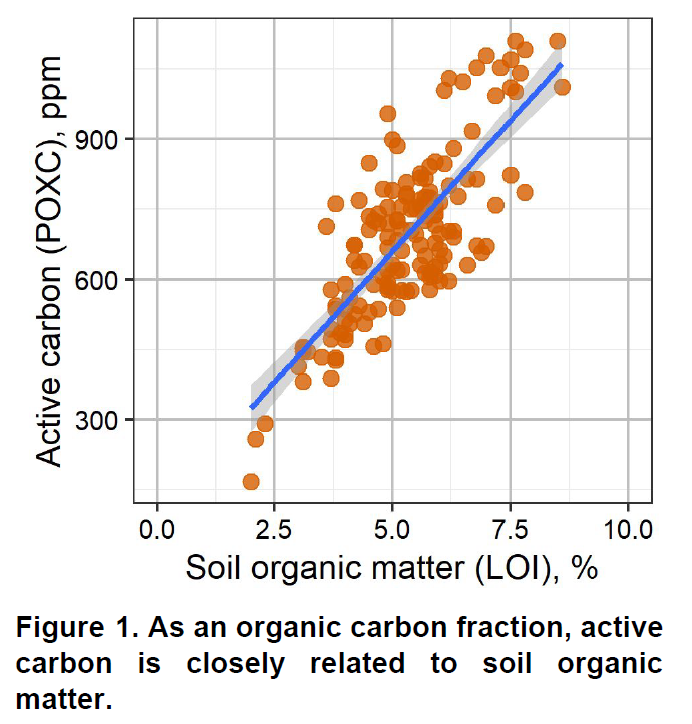
Active carbon typically comprises about 1 to 4% of total organic carbon in soil. It represents the microbially available carbon energy sources, that is microorganism food. As one component of the total organic carbon pool, active carbon has a strong relationship with overall soil organic matter (r = 0.80, Fig. 1), but it responds more quickly to changes in crop and soil management. It helps explain why two soils with 3% soil organic matter, for example, may behave differently regarding biological activity or nutrient cycling.
Active carbon should be utilized as a tracking tool to measure improvement in soil quality. In a 17-year tillage experiment in Mandan, ND, total organic carbon did not change much after conversion to no-till; however, active carbon increased significantly from 470 to 600 ppm (Weil et al., 2003). Recall that soil organic matter includes all forms of organic carbon (i.e. microbial biomass, recently decomposed plant material, stable humus) and requires large carbon inputs to change that total measurement. In contrast, the active carbon fraction increases much more quickly and detects improvements in soil quality sooner. This is why active carbon is considered a “leading” soil health indicator.
What do the numbers mean?
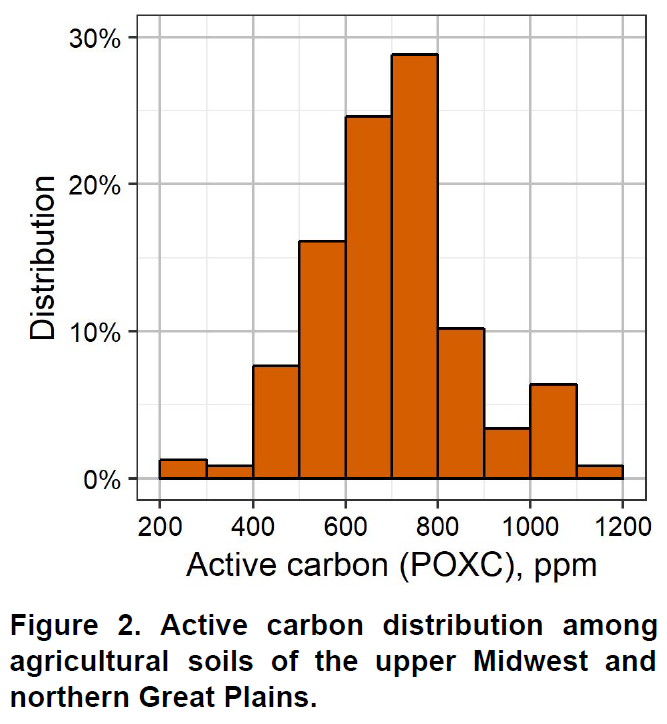
In agricultural soils of the upper Midwest and northern Great Plains, active carbon commonly ranges from less than 300 ppm to 1000 ppm (Fig. 2). As with soil organic matter, soil texture is a major factor controlling active carbon. Coarse-textured soils generally contain less active carbon than medium- or fine-textured soils. Native prairie soils may contain active carbon as high as 1500 ppm.
While these are the common active carbon values you may expect, each field and its history is different; therefore, making comparisons between fields is not advised. There are no index ranges for active carbon because different climatic regions and soil types cannot be judged by the same standard. Active carbon should be utilized as a tracking tool in improving the soil quality of that field or zone, rather than making broadscale comparisons.
Cropping systems that include reduced tillage or no-till, diversified crop rotations, and cover crops will help increase active carbon. In addition, any system with greater organic matter inputs (e.g., plant biomass, manure) helps build active carbon and soil organic matter. Under perennial grass, active carbon can easily exceed 1000 ppm.
With sensitive soil health tools like active carbon, you can more easily quantify positive changes achieved through better soil management.
How to soil sample
Active carbon can be added to any standard soil fertility analysis, simply requested as an analysis add-on. Collect the soil sample with standard soil probe. The standard soil sampling depth of 0-6 inches is most common. In reduced tillage and no-till systems, stratification may warrant 0-2 or 0-4 inch soil sampling depths. Like any soil health test, it is a tracking tool measuring soil quality improvement, so make sure you are using GPS-marked soil sampling points.
Frequently asked questions (FAQ)
Q: Does higher active carbon (POXC) indicate better crop yield?
A: Not necessarily. Crop yield is comprised of numerous determinants: genetics, climate, soil type, soil fertility, crop pests, etc. Active carbon measures the carbon sources available to microorganisms as food. This is only one factor within a wide range of various soil biological functions and yield-determining factors. Soil management practices that can improve crop production, such as no-till in water-limited environments, also work to improve soil properties like active carbon.
Q: Can I use active carbon to reduce fertilizer rates or modify plant population?
A: Active carbon has NOT been calibrated with fertilizer rate or plant population trials. So far, active carbon provides information on soil management . The relationships with crop productivity remain unclear. We must wait for more research to answer these yield-focused questions.
References
Weil, R.R., K.R. Islam, M.A. Stine, J.B. Gruver, and S.E. Samson-Liebig. 2003. Estimating active carbon for soil quality assessment: A simplified method for laboratory and field use. Am. J. Altern. Agric. 18(1):3–17.

Sidedress Nitrogen for Corn Using the Pre-Sidedress Soil Nitrate Test (PSNT)
in Corn, In-Season Fertilizer, Nitrogen, Soil Sampling/by John BrekerAs the corn crop begins to emerge, it is time to prepare for sidedress nitrogen applications. Sidedress nitrogen for corn can be applied any time after planting, but the target application window is generally between growth stages V4 and V8 before rapid plant nitrogen uptake occurs. Split nitrogen applications have become a standard practice in corn to reduce in-season nitrogen losses on vulnerable soils, such as sandy and clayey soils. More and more farmers now include topdress or sidedress nitrogen as part of their standard nitrogen management plan. These farmers have witnessed too many years of high in-season nitrogen losses through nitrate leaching or denitrification.
The target timing for PSNT sampling is when corn is 6 to 12 inches tall at the whorl, often near V4 or V5 growth stage (pictured above). Do not hesitate in collecting soil samples for the PSNT; the target window for sidedress nitrogen applications in corn is between the V4 and V8 growth stages.
Whether your nitrogen management plan includes a planned sidedress nitrogen application, or if this is now your first opportunity to apply nitrogen to corn this spring, the Pre-Sidedress Soil Nitrate Test (PSNT) is one tool to help make decisions about in-season nitrogen. You may also hear this called the Late-Spring Soil Nitrate Test (LSNT) in Iowa. PSNT is an in-season soil nitrate test taken during the early growing season to determine if additional nitrogen fertilizer is needed. PSNT helps assess available soil nitrate-nitrogen prior to rapid plant nitrogen uptake and the likelihood of crop yield response to additional nitrogen.
The PSNT can also help you decide the appropriate sidedress nitrogen rate. The PSNT requires a 0-12 inch depth soil sample taken when corn plants are 6 to 12 inches tall (at the whorl), usually in late May or early June. The soil sample is analyzed for nitrate-N. Late-planted corn may not reach that height before mid-June, but PSNT soil samples should still be collected during the first two weeks of June. The recommended soil sampling procedure requires 16 to 24 soil cores taken randomly through the field, staggering your soil cores across the row as you go. All soil cores should be placed in the soil sample bag and submitted to the laboratory within 24 hours or stored in the refrigerator.
You can submit PSNT soil samples using the online AGVISOR portal by choosing the “Corn Sidedress N” crop choice and submitting a 0-12 inch soil sample for nitrogen (nitrate-N) analysis. AGVISOR will generate sidedress nitrogen fertilizer guidelines, using the Iowa State University PSNT critical level of 25 ppm nitrate-N (0-12 inch depth). If PSNT is greater than 25 ppm nitrate-N, then the probability of any corn yield response to additional nitrogen is low. If spring rainfall was above normal, then the PSNT critical level of 20 to 22 ppm nitrate-N (0-12 inch depth) should be used. Iowa State University provides additional PSNT interpretation criteria for excessive rainfall, manured soils, and corn after alfalfa.
If the PSNT is taken after excessive rainfall, the soil cores can be very wet and difficult to mix in the field. Therefore, it is best to send all soil cores to the laboratory to be dried and ground, ensuring a well-homogenized soil sample for analysis. Although in-field soil nitrate analyzers have improved over the years, the difficult task of blending wet, sticky soil cores in the field still remains. The only way to get accurate, repeatable soil analysis results is to dry, grind, and homogenize the entire soil sample in the laboratory before analysis. AGVISE provides next-day turnaround on PSNT soil samples. The soil samples are analyzed and reported the next business day after arrival at the laboratory. The soil test results will be posted to the online AGVISOR portal for quick and easy access.
More resources on the Pre-Sidedress Soil Nitrate Test (PSNT)
How Much AMS Does Your Spray Water Need?
in Water Quality/by Jodi BoeHard water is common issue for many water sources across the upper Midwest, Great Plains, and Canadian Prairies. It is why our homes have water softeners, why our well water tastes funny (or delicious), and one reason we need to add AMS (ammonium sulfate) or UAN to spray tanks to optimize weed control.
When we talk about conditioning “hard water” for herbicide applications, we are trying to prevent dissolved salts in water (e.g., calcium, magnesium, sodium, potassium, iron) from antagonizing, or binding, the pesticide in the sprayer tank. Dissolved salts bind to weak-acid, salt-formulated pesticides and reduce their efficacy (e.g., glyphosate [RoundUp], growth regulators, ACCase inhibitors [Select, Axial, etc.], ALS inhibitors [Pursuit, Express, etc.], HPPD inhibitors [Callisto etc.], and glufosinate [Liberty]).
A water conditioner like AMS helps prevent salts in spray water from binding to pesticides. AMS is most often recommended at rates from 8.5 to 17 lb/100 gal spray volume on herbicide labels. This is a wide window, and handling dry AMS can be a pain. So, how do you know how much AMS you should add to the tank to overcome the antagonism? A spray water analysis!
Example spray water report with suggested AMS rate calculation.
AGVISE Laboratories provides fast and convenient analysis of spray water used for pesticide applications. The Spray Water Analysis package includes calcium, magnesium, sodium, iron, pH, salt, hardness, and SAR (sodium adsorption ratio). The spray water report utilizes NDSU research and data to calculate the suggested amount of AMS required per 100 gallons of water to overcome antagonism. You will want to test each water source you use for pesticide applications.
Please give us a phone call at our offices in Benson, MN (320-843-4109), or Northwood, ND (701-587-6010), and we will send you a water sample kit. Each kit contains a water sample jar and a water sample submission sheet. Water sample tests are completed within a week and results are emailed to you, so you have information on your water source right away.
Don’t let salts take away from your weed control – get your spray water tested!
2021 Plant Nutrient Deficiency Troubleshooting Project
in Troubleshooting/by Jodi BoePlant analysis is a valuable tool for managing plant nutrients and troubleshooting agronomic problems. Being certain that a specific plant nutrient is causing deficiency symptoms is difficult with visual symptoms alone. Many causal agents unrelated to soil fertility can cause symptoms that appear to be nutrient-related. There are also some plant nutrient deficiencies that are impossible to determine visually so we call them a “hidden hunger.” For troubleshooting situations, you will need a pair of good and bad plant samples, along with good and bad soil samples, to discover the real answer to what is happening in the field (nutrient deficiency or something else).
To help you troubleshoot problem areas and get familiar with plant analysis, AGVISE Laboratories is sponsoring the Plant Nutrient Deficiency Troubleshooting Project in 2021. We are looking to work with 50 to 100 customers this summer who see apparent nutrient deficiency symptoms in one of their fields and want to be involved in this educational project. Volunteering in this project will help you figure out if a problem area in a field is caused by a plant nutrient deficiency or something else. If you want to volunteer, contact one of our agronomists or soil scientists in Northwood (701-587-6010) or Benson (320-843-4109) as soon as you have a problem area you want to troubleshoot for this project. Immediacy is key for good data. The results may be inconclusive if you wait to take plant samples 7 to 10 days after symptoms first appear because new problems can arise.
Once you have spoken with one of our staff and described the problem in your field, we will send you the supplies packet to submit good and bad plant samples, as well as good and bad soil samples (0- 6 inch). If you can provide us with good photographs to aid in the problem diagnosis, we will cover the soil and plant analysis fees (two complete tissue analyses and two complete soil analyses; $151.20 USD retail value).
It is important to catch plant nutrient deficiencies early while you still have time to make a rescue fertilizer application. Take advantage of the AGVISE Plant Nutrient Deficiency Troubleshooting Project and solve those problems the right way… right away.
New Address for AGVISE Laboratories Canada Receiving Facility
in AGVISE Laboratories/by Jodi BoeThe AGVISE Laboratories Canadian Receiving Facility has moved across the street from its former location in Winkler, Manitoba. What this means for customers sending samples to our Canadian Receiving Facility:
If you have any questions, please give us a call at 701-587-6010.
Livestock Manure Sampling and Analysis
in Manure/by John LeeAs you develop crop nutrition plans for the upcoming year, it is important to include spring manure application in the crop nutrition budget. Manure is an excellent source of plant-available nutrients and offers nice economic savings, especially with high fertilizer prices. When manure is applied properly, you can maximize the nutrient value, reduce nutrient losses, and comply with government regulations.
A proper manure nutrient management plan starts with soil and manure analysis. AGVISE Laboratories provides both soil and manure analysis as routine services to help you develop the right manure nutrient management plan. You might find “book values” with average manure nutrient contents for different manure types, but there is a lot of variability among manure sources from farm to farm. Would you purchase commercial fertilizer without knowing the nutrient analysis? I do not think so! The manure nutrient concentrations vary widely because of dry matter/moisture content, livestock species and age, bedding type, and feed rations. Each year, AGVISE analyzes thousands of manure samples, and the nutrient content range can be very large (Figure 1). A manure analysis is a quick way to know the dollar value in your manure.
Figure 1. Manure nutrient characteristics of manure samples sent to AGVISE Laboratories, 2013-2020. For any nutrient and manure type, there is substantial variability from manure source to source. The box-and-whisker plot represents the median (middle) nutrient content at the thick middle bar, the 50th-percentile range within the box, and the minimum and maximum variability with the whiskers.
A good manure analysis starts with a good manure sample. Here are a few tips and tricks in collecting a representative manure sample. AGVISE provides manure sample containers at no cost, so please contact us if you need manure sampling supplies.
Solid Manure
Collect several small manure samples using a shovel or pitchfork in the manure pile or bedding area, place in a clean plastic bucket. Avoid the top or edges of the pile where a crust has formed. Mix the bulk sample well, then submit one subsample for analysis in plastic jar (about 1 pint). Store in refrigerator or freezer until shipped. Place in tightly sealed plastic bag to prevent leakage in shipment. Multiple samples may be necessary if the storage area includes manure for different lengths of time.
Liquid Manure
Before sampling, the liquid storage system must be agitated to mix liquid and solids. Collect several samples in a clean plastic bucket. Mix the bulk sample well, then submit one subsample for analysis in a plastic jar (about 1 pint). Store in refrigerator or freezer until shipped. Place in tightly sealed plastic bag to prevent leakage in shipment.
Once the manure analysis results are back, you can begin creating a manure nutrient management plant with the soil and manure test results. The soil test results will determine the crop nutrient requirements to maximize crop yield and profitability. Then, subtract the amount of crop nutrients provided in manure, and apply any remaining crop nutrient requirements with commercial fertilizer. A good manure nutrient management plan will help you maximize economic return on manure inputs. In addition, check with local and regional government agencies for any special requirements in your area.
In recent decades, regulation and public concerns have changed the way we handle manure nutrient management. It is a valuable nutrient resource, which when managed properly, can increase profitability, improve soil properties, and protect the environment.
For additional information on manure analysis and land application, these are some helpful online publications. If you have any questions on manure analysis, please contact the AGVISE technical support team.
Manure Sampling and Nutrient Analysis (University of Minnesota)
Step-by-step Manure Rate Calculations (University of Minnesota)
Manure Application Methods and Nitrogen Losses (University of Minnesota)
Manure Management Guidelines and Fact Sheets (Manitoba Agriculture)
Starter Fertilizer: Choosing the Right Seed-Safe Rate
in Corn, Starter Fertilizer, Wheat/by John LeeStarter fertilizer placed with or near the seed is essential for vigorous early season growth in grass crops such as corn and wheat. We plant these crops early because we know vigorous early season growth is important to achieving high crop yields. Early planting also means cold soils, and starter fertilizer is necessary to get the crop going with a good start. Each spring, we receive many questions about starter fertilizer placement and seed-safe fertilizer rates. These questions come from farmers who want to plant as many acres per day as possible, take advantage of more efficient banded phosphorus placement, and of course reduce fertilizer costs.
The two most common questions we get are “What is highest rate of starter fertilizer I can apply with the seed?” and “What is the lowest rate of starter fertilizer I can apply with the seed and still get a starter effect?” South Dakota State University (SDSU) made a downloadable spreadsheet that calculates the maximum seed-safe fertilizer rate (Figure 1). The spreadsheet will ask for the crop choice, fertilizer product, seed opener width, row spacing, tolerable stand loss, soil texture, and soil water content. The spreadsheet calculations are based on SDSU greenhouse and field studies.
Figure 1. Fertilizer Seed Decision Aid from South Dakota State University. Download the spreadsheet here.
Research has shown, that to achieve the full starter effect, a fertilizer granule or droplet must be within 1.5 to 2.0 inches of each seed. If the fertilizer granule or droplet is more than 1.5 to 2.0 inches away from the seed, the starter effect is lost. To illustrate the role of starter fertilizer rates and seed placement, AGVISE created displays showing the distance between fertilizer granules or droplets at various rates and row spacings. For example, take a look at wheat planted in 7-inch rows with 30 lb/acre P2O5 (57 lb/acre 11-52-0) and corn planted in 30-inch rows with 30 lb/acre P2O5 (7.5 gal/acre 10-34-0). You need to maintain a sufficient starter fertilizer rate to keep fertilizer granules or droplets with 1.5 to 2.0 inches of each seed.
Figure 2. Two examples from the AGVISE Starter Fertilizer Display series. Find more crops and fertilizer rates here.
In the northern Great Plains and Canadian Prairies, most fertilizer is applied at planting and often as seed-placed fertilizer. This creates a challenge to prevent soil nutrient mining when balancing seed safety and crop nutrient removal with higher crop yield potential. Soil nutrient mining occurs when you apply less fertilizer than crop nutrient removal, resulting in soil test P and K decline over time. Some broadleaf crops, like canola and soybean, are very sensitive to seed-placed fertilizer, allowing only low seed-placed fertilizer rates. In contrast, most cereal crops can tolerate higher seed-placed fertilizer rates. To maintain soil nutrient levels across the crop rotation, you need to apply more phosphorus fertilizer in crops that allow greater seed safety. You can apply more phosphorus fertilizer with crops like corn or wheat, which allows you build soil test P in those years, while you mine soil test P in canola or soybean years. If you cannot the maintain crop nutrient removal balance with seed-placed fertilizer, then you need to consider applying additional phosphorus in mid-row bands or broadcast phosphorus at some point in the crop rotation.
Table 1. Seed-safe fertilizer rates may not meet crop removal. In the example, the seed-safe limit is based on 1-inch disk or knife opener and 7.5-inch row spacing for air-seeded crops and 30-inch row spacing for corn. Phosphorus (P) balance: Seed-safe limit (lb/acre P2O5) minus crop P removal (lb/acre P2O5). A negative P balance indicates the seed-safe limit does not meet crop removal, which may decrease soil test P.
Starter fertilizer is an important part of any crop nutrition plan. Here are more resources to help you make the best decisions on starter fertilizer materials, placement, and rates.
Fertilizer Application with Small Grain Seed at Planting, NDSU
Safe Rates of Fertilizer Applied with the Seed, Saskatchewan Agriculture
Using banded fertilizer for corn production, University of Minnesota
Corn response to phosphorus starter fertilizer in North Dakota, NDSU
Preparing for Spring Soil Sampling
in Equipment/by John LeeEven when fall soil sampling weather cooperates, there is always some soil sampling to do each spring. No matter the spring conditions, the soil sampling window is tight if you are planning to collect soil samples and get the soil test results back in time for spring fertilizer decisions. You will want to pull soil samples before the field will carry a pickup truck, without leaving deep ruts, to maximize the spring soil sampling window. Your soil sampling rig choices are usually walking the field with a hand soil probe or using an ATV/UTV.
Over the years, many creative clients have outfitted UTVs with hydraulic soil sampling equipment to collect 24-inch soil cores in the spring. This has allowed soil samplers to get into a field about one week before it could carry a pickup truck. It is a big deal if you can get soil test results back one week sooner in the spring!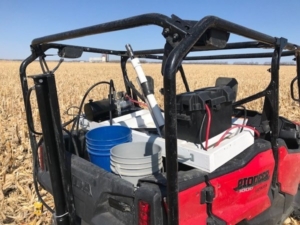
It is fairly simple to rig a UTV with the receiver hitch-mounted hydraulic soil sampling system kit. All you need to build is a wooden box to hold the electric-hydraulic power unit and a large starter battery. The hydraulic cylinder is mounted on a channel iron, which simply attaches to the receiver hitch. A large starter battery has enough charge to complete a good day of soil sampling without a recharge. Just make sure you put the battery on the charger overnight.
Some clients have created hydraulic soil sampling systems that can be quickly added and removed from a pickup truck box or UTV. It is a quick and easy add-on for the couple weeks of spring soil sampling that you may do. If you want some simple designs for self-contained soil sampling systems that can be removed in 10 minutes or less, these are some examples to consider.
Once the soil sample is collected, the next step in successful spring soil testing is getting them analyzed ASAP. AGVISE Laboratories knows that every spring soil sample is a rush, and our normal turnaround time is next-day (24 hours after soil sample is received). If you need any soil sampling equipment or supplies, we have everything in stock to ensure you get spring soil testing completed on time. We know spring soil testing can be stressful, but we hope to make it easier with the right soil sampling equipment and the reliable soil testing services that AGVISE has provided since 1976.
Adjusting high soil pH and salinity with sugar beet-processing spent lime
in Research, Saline and Sodic Soil, Soil Amendment, Soil pH/by John LeeThe sugar beet processing industry uses large quantities of fine-ground, high-grade calcium carbonate (lime) to purify sucrose in the sugar extraction process. The by-product spent lime retains high reactivity and purity, making it an attractive liming material for acidic soils. Application of spent lime is a common practice through the sugar beet producing areas of the upper Midwest and northern Great Plains, where its primary function is the suppression of the soil-borne disease Aphanomyces root rot of sugar beet. The spent lime also contains about 20 lb P2O5 per ton, mostly as organic phosphorus impurities gained from sugar refining.
We often get questions about correcting high soil pH and salinity with spent lime. Salt-affected soils, saline and sodic, are a common problem across the northern Great Plains. These soils have high soil pH and present numerous agronomic and soil management problems. The soil amendment gypsum (calcium sulfate) is often applied to sodic soils (those with high sodium) to combat soil swelling and dispersion. The spent lime (calcium carbonate) also contains calcium, but it is very insoluble at high soil pH.
Each year, we get many questions about applying spent lime on soils with high pH and salinity. To answer these questions, AGVISE Laboratories installed a long-term demonstration project in 2008 to evaluate adjusting high soil pH and salinity with spent lime. We applied multiple spent lime rates and tracked soil test levels over seven years. There were no significant changes or trends in soil pH (Table 1) or salinity (Table 2). This is no surprise because the initial soil pH was high and buffered around 7.8-8.2, indicating the presence of natural calcium carbonate. If the soil already contains naturally occurring lime, what is the good of adding more lime? Moreover, calcium carbonate is very insoluble, so there is no expectation that more lime will decrease or increase salinity.
Since soil test levels did not change over seven years, we terminated the project in 2014. The research question was a conclusive dud. While spent lime is useful to amend acidic soils and suppress Aphanomyces root rot of sugar beet, it does not help on soils with high pH or salinity.
Soil Testing and 4R Nutrient Stewardship
in AGVISE Laboratories, Environment, Precision Ag/by John BrekerEach year, farmers aim to increase agricultural production and profitability while conserving our land resources for the next generation. These tandem goals drive sustainable soil fertility and crop nutrition decisions on cropland across the world.
In 2005, global fertilizer industry and environmental stakeholders began developing a standard theme to emphasize science-based stewardship in soil fertility and crop nutrition. The theme eventually became known as 4R Nutrient Stewardship, where each “R” referred to the “right” way to manage nutrients for crop production. The 4Rs are summarized as managing crop nutrition with the 1) Right Source, 2) Right Rate, 3) Right Time, and 4) Right Place.
To successfully implement 4R Nutrient Stewardship, you must start with a high-quality soil sample and an informative soil test. To begin, the fertilizer need and amount is determined through soil testing, which is based on regionally calibrated soil test levels for each crop. If you do not have a soil test, how do you know what the Right Rate is? Using crop removal rates or simply guessing without soil testing often leads to overapplication of fertilizer, cutting into profit.
A conventional whole-field composite soil sample (one soil sample per field) is certainly better than no soil sample. It gets you in the ballpark, but it does not detect variation in soil nutrient levels across the field. You might underapply fertilizer on high yielding parts and overapply fertilizer on low yielding parts. To get the Right Rate applied in the Right Place, precision soil sampling, either grid or zone, is the best way to determine the appropriate fertilizer rate and where to apply it in each field. Precision soil sampling is a proven tool to reduce over- and under-fertilization across fields, thus optimizing crop yield and profitability while reducing the potential risk of soil nutrient loss to the environment.
When you start soil sampling and making soil fertility plans for next year, keep 4R Nutrient Stewardship in mind. AGVISE Laboratories is a proud 4R Partner. To learn more about the 4Rs or become a 4R Partner, visit the 4R Nutrient Stewardship website.
Active carbon (POXC): What does it measure?
in Soil Chemical Analysis, Soil Health/by John BrekerCarbon is the currency of nature: the backbone of soil organic matter and the energy source for soil microorganisms. Therefore, much interest in soil health focuses on increasing carbon storage in soil. When you reduce tillage or increase crop rotation diversity, you expect soil organic matter to increase. However, soil organic matter often changes slowly for several years. In fact, less than 1% of plant biomass carbon returned to soil eventually becomes stable humus organic carbon.
Active carbon, also known as permanganate-oxidizable carbon (POXC), is a sensitive tool for measuring soil carbon change. This portion of soil organic matter is actively involved in nutrient cycling and changes more quickly when cropping systems are changed (e.g. reduced tillage, diversified crop rotation, cover crop inclusion). Active carbon is a quick, repeatable soil test that measures the easily oxidizable, biologically active carbon fraction.
Why is active carbon important?
Active carbon typically comprises about 1 to 4% of total organic carbon in soil. It represents the microbially available carbon energy sources, that is microorganism food. As one component of the total organic carbon pool, active carbon has a strong relationship with overall soil organic matter (r = 0.80, Fig. 1), but it responds more quickly to changes in crop and soil management. It helps explain why two soils with 3% soil organic matter, for example, may behave differently regarding biological activity or nutrient cycling.
Active carbon should be utilized as a tracking tool to measure improvement in soil quality. In a 17-year tillage experiment in Mandan, ND, total organic carbon did not change much after conversion to no-till; however, active carbon increased significantly from 470 to 600 ppm (Weil et al., 2003). Recall that soil organic matter includes all forms of organic carbon (i.e. microbial biomass, recently decomposed plant material, stable humus) and requires large carbon inputs to change that total measurement. In contrast, the active carbon fraction increases much more quickly and detects improvements in soil quality sooner. This is why active carbon is considered a “leading” soil health indicator.
What do the numbers mean?
In agricultural soils of the upper Midwest and northern Great Plains, active carbon commonly ranges from less than 300 ppm to 1000 ppm (Fig. 2). As with soil organic matter, soil texture is a major factor controlling active carbon. Coarse-textured soils generally contain less active carbon than medium- or fine-textured soils. Native prairie soils may contain active carbon as high as 1500 ppm.
While these are the common active carbon values you may expect, each field and its history is different; therefore, making comparisons between fields is not advised. There are no index ranges for active carbon because different climatic regions and soil types cannot be judged by the same standard. Active carbon should be utilized as a tracking tool in improving the soil quality of that field or zone, rather than making broadscale comparisons.
Cropping systems that include reduced tillage or no-till, diversified crop rotations, and cover crops will help increase active carbon. In addition, any system with greater organic matter inputs (e.g., plant biomass, manure) helps build active carbon and soil organic matter. Under perennial grass, active carbon can easily exceed 1000 ppm.
With sensitive soil health tools like active carbon, you can more easily quantify positive changes achieved through better soil management.
How to soil sample
Active carbon can be added to any standard soil fertility analysis, simply requested as an analysis add-on. Collect the soil sample with standard soil probe. The standard soil sampling depth of 0-6 inches is most common. In reduced tillage and no-till systems, stratification may warrant 0-2 or 0-4 inch soil sampling depths. Like any soil health test, it is a tracking tool measuring soil quality improvement, so make sure you are using GPS-marked soil sampling points.
Frequently asked questions (FAQ)
Q: Does higher active carbon (POXC) indicate better crop yield?
A: Not necessarily. Crop yield is comprised of numerous determinants: genetics, climate, soil type, soil fertility, crop pests, etc. Active carbon measures the carbon sources available to microorganisms as food. This is only one factor within a wide range of various soil biological functions and yield-determining factors. Soil management practices that can improve crop production, such as no-till in water-limited environments, also work to improve soil properties like active carbon.
Q: Can I use active carbon to reduce fertilizer rates or modify plant population?
A: Active carbon has NOT been calibrated with fertilizer rate or plant population trials. So far, active carbon provides information on soil management . The relationships with crop productivity remain unclear. We must wait for more research to answer these yield-focused questions.
References
Weil, R.R., K.R. Islam, M.A. Stine, J.B. Gruver, and S.E. Samson-Liebig. 2003. Estimating active carbon for soil quality assessment: A simplified method for laboratory and field use. Am. J. Altern. Agric. 18(1):3–17.