

• Shopping Cart Shopping Cart
    0Shopping Cart
Agvise Laboratories
  • Services
    • For Agriculture
    • For Lawn & Garden
    • For GLP Clients
    • AGVISOR Login
    • Pay Invoice Online
  • Resources
    • Forms & Guides
    • Agronomy Blog
    • Newsletter
    • Soil Test Summary
    • Seminars & Events
    • Precision Ag Helpers
    • Sign Up for Updates
  • Store
    • Hand Equipment
      • Soil Probe Handle
      • Soil Probe Tube
      • Accessories
    • Hydraulic Equipment
      • Soil Sampling System Kit
      • Power Unit
      • Soil Probe – Quicktach
      • Accessories
      • Replacement Parts
      • Wintex 1000
      • Used Equipment
    • Soil Grinding Equipment
      • Soil Grinding System
      • Replacement Parts
    • Supplies
      • Submission Forms
      • Bags and Containers
      • Shipping
      • Research Project Media
  • About Us
    • People
    • History
    • Certifications
  • Contact Us
    • Email
    • Locations
    • Employment
    • Update Contact Information
  • AGVISOR Login
  • Pay Invoice
  • Menu Menu
Blog
John Breker

Soil Testing and 4R Nutrient Stewardship

March 5, 2021/in AGVISE Laboratories, Environment, Precision Ag/by John Breker

Each year, farmers aim to increase agricultural production and profitability while conserving our land resources for the next generation. These tandem goals drive sustainable soil fertility and crop nutrition decisions on cropland across the world.

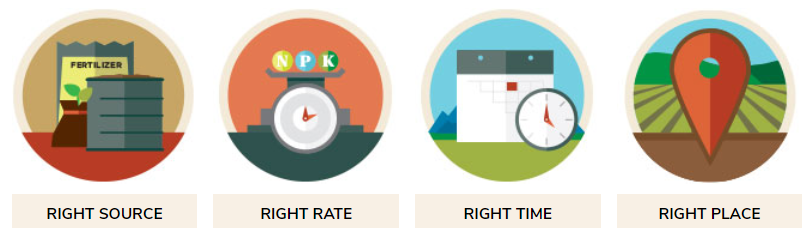
In 2005, global fertilizer industry and environmental stakeholders began developing a standard theme to emphasize science-based stewardship in soil fertility and crop nutrition. The theme eventually became known as 4R Nutrient Stewardship, where each “R” referred to the “right” way to manage nutrients for crop production. The 4Rs are summarized as managing crop nutrition with the 1) Right Source, 2) Right Rate, 3) Right Time, and 4) Right Place.
To successfully implement 4R Nutrient Stewardship, you must start with a high-quality soil sample and an informative soil test. To begin, the fertilizer need and amount is determined through soil testing, which is based on regionally calibrated soil test levels for each crop. If you do not have a soil test, how do you know what the Right Rate is? Using crop removal rates or simply guessing without soil testing often leads to overapplication of fertilizer, cutting into profit.

A conventional whole-field composite soil sample (one soil sample per field) is certainly better than no soil sample. It gets you in the ballpark, but it does not detect variation in soil nutrient levels across the field. You might underapply fertilizer on high yielding parts and overapply fertilizer on low yielding parts. To get the Right Rate applied in the Right Place, precision soil sampling, either grid or zone, is the best way to determine the appropriate fertilizer rate and where to apply it in each field. Precision soil sampling is a proven tool to reduce over- and under-fertilization across fields, thus optimizing crop yield and profitability while reducing the potential risk of soil nutrient loss to the environment.

When you start soil sampling and making soil fertility plans for next year, keep 4R Nutrient Stewardship in mind. AGVISE Laboratories is a proud 4R Partner. To learn more about the 4Rs or become a 4R Partner, visit the 4R Nutrient Stewardship website.

Share:
  • Share on Facebook
  • Share on X
  • Share on WhatsApp
  • Share on LinkedIn
  • Share by Mail
https://www.agvise.com/wp-content/uploads/2020/05/agvise_page_logo_png.png 0 0 John Breker https://www.agvise.com/wp-content/uploads/2020/05/agvise_page_logo_png.png John Breker2021-03-05 16:12:452021-03-05 16:12:45Soil Testing and 4R Nutrient Stewardship

Article Categories

  • AGVISE Laboratories
    • Quality Control
    • Regional Data
    • Research
  • Crop Management
    • Canola
    • Corn
    • Cover Crop
    • Lawn and Garden
    • Potato
    • Prevented Planting
    • Soybean
    • Sugar Beet
    • Sunflower
    • Wheat
  • Environment
    • Drought
    • Water Quality
  • Fertilizer
    • Crop Removal
    • Fertilizer Placement
    • In-Season Fertilizer
    • Starter Fertilizer
  • Integrated Pest Management
    • Disease
    • Weed
  • Manure
  • Plant Analysis
    • Troubleshooting
  • Soil Analysis
    • Soil Biological Analysis
    • Soil Chemical Analysis
    • Soil Physical Analysis
  • Soil Fertility and Plant Nutrition
    • Base Cation Saturation Ratio
    • Calcium
    • Micronutrients
      • Copper
      • Iron
      • Molybdenum
      • Zinc
    • Nitrogen
    • Phosphorus
    • Potassium
    • Soil pH
    • Sulfur
  • Soil Health
  • Soil Management
    • Saline and Sodic Soil
    • Soil Amendment
    • Soil Erosion
    • Tillage
  • Soil Sampling
    • Equipment
    • Precision Ag

Northwood Laboratory

804 Hwy 15 West
P.O. Box 510
Northwood, ND 58267
Phone: 701-587-6010
Fax: 701-587-6013

Benson Laboratory

902 13th Street North
P.O. Box 187
Benson, MN 56215
Phone: 320-843-4109
Fax: 320-843-2074

Canada Shipping Address

380 Kimberly Road
Winkler, MB R6W 0H7
Phone: 701-587-6010


© Copyright - Agvise Laboratories Privacy Policy   Cookie Policy
  • Link to X
  • Link to LinkedIn
  • Link to Facebook
  • Link to Youtube
  • Home
  • Services
  • Resources
  • Store
  • About Us
  • Contact Us
Link to: Active carbon (POXC): What does it measure? Link to: Active carbon (POXC): What does it measure? Active carbon (POXC): What does it measure? Link to: Adjusting high soil pH and salinity with sugar beet-processing spent lime Link to: Adjusting high soil pH and salinity with sugar beet-processing spent lime Adjusting high soil pH and salinity with sugar beet-processing spent lime
Scroll to top