

Soil aggregate stability: What does it measure?
Soil aggregates are the building blocks of soil structure. Soil texture is the relative percentage of sand, silt, and clay in soil, but soil structure describes how those particles are arranged in the soil profile. Soil aggregates are glued together with soil organic matter, plant root exudates, and microorganisms like fungi.
We classify soil aggregates by their size: large macroaggregates (>2000 μm), macroaggregates (250-2000 μm), microaggregates (53-250 μm), and free particles (<53 μm). A large macroaggregate is bigger than a sand particle. A microaggregate has the thickness of one or two human hairs. A macroaggregate lies in between.
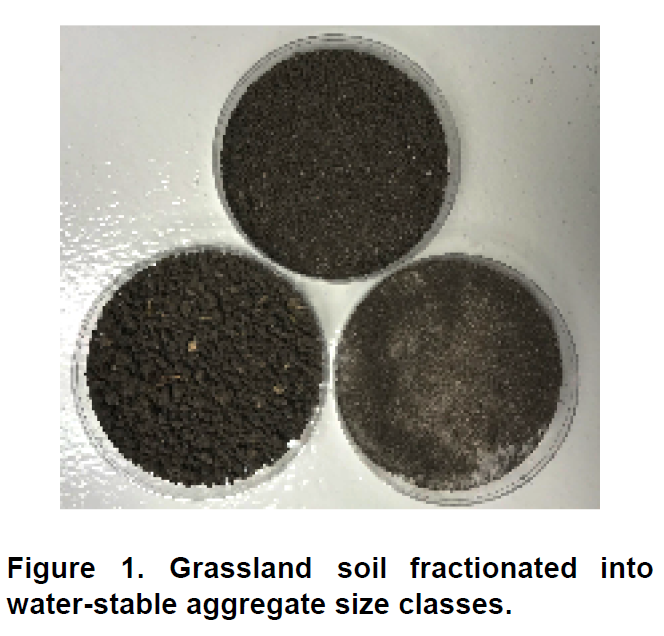
Multiple soil management practices come together to improve soil aggregate stability. These include reduced tillage or no-till, greater crop rotation diversity, more plant roots, greater earthworm and microbial activity, and more soil organic matter. This is what makes soil aggregate stability such an attractive soil health indicator. Stable soil aggregates take time to form, so you should consider measuring soil aggregate stability every 3 to 5 years.
Why is soil aggregate stability important?
Soil aggregate stability is a comprehensive soil quality measurement. Soil aggregates provide numerous soil ecosystem services:
● Resistance to water and wind erosion
● More pore space for air and water movement, allowing deep root exploration
● Faster water infiltration, reduced runoff
● Less surface crusting
● Improved equipment trafficability and reduced soil compaction, especially on wet soils
● Diverse habitat for soil microorganisms
Strong soil aggregates form naturally with plant root and microbial activity. However, disturbances like tillage quickly break soil aggregates apart. If soil aggregates are broken apart by tillage, the soil pores fill with small particles that can clog and restrict air and water movement. Loose soil particles can also plug the surface pore network to reduce water infiltration and cause surface crusting.
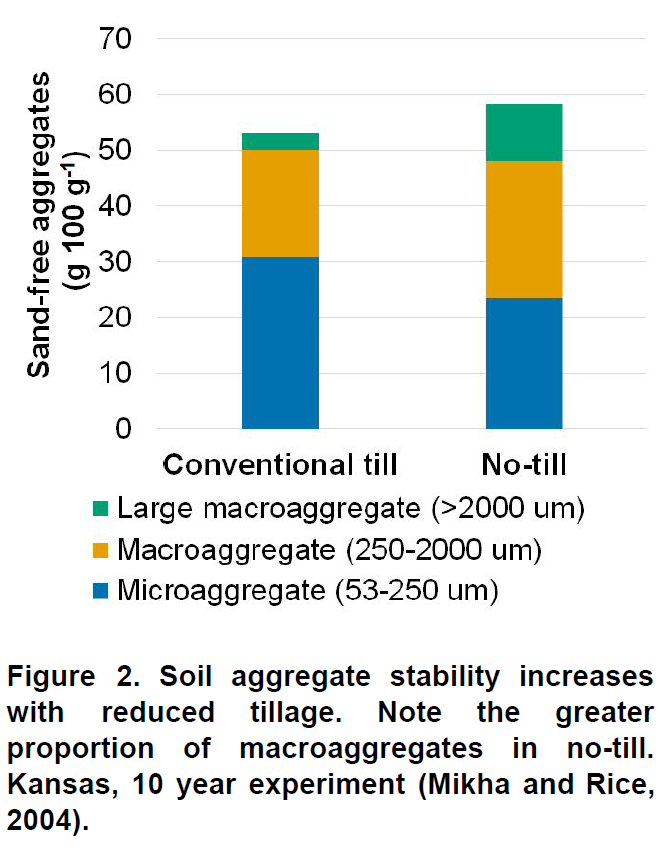
Cropping systems that include reduced tillage or no-till are necessary to improving soil aggregate stability (Figure 2). Tillage also reduces soil organic matter that is needed to bind soil particles into larger soil aggregates. Diversified crop rotations, cover crops, and manure help improve soil aggregate formation.
Soil texture is a major factor in soil aggregate formation. Coarse-textured soils may take longer to develop soil aggregates. Fine-textured soils tend to develop soil aggregates quickly. This is important because good soil structure with large pore spaces is essential to air and water movement through fine-textured soils.
What do the numbers mean?
You can see large soil aggregates (>2000 μm) with the naked eye, but quantifying the different water-stable soil aggregate sizes must be done in the laboratory. This requires special wet sieving equipment that sorts the water-stable soil aggregates by size.
If you see the water-stable macroaggregate fractions increasing, you know that you are making real improvements in soil quality. Soils with high soil aggregate stability have less soil erosion, better equipment trafficability, faster water infiltration, and more diverse habitat for soil microorganisms. Increasing soil aggregate stability should be a long-term goal in all cropping systems.
Soil aggregate stability should be utilized as a tracking tool in improving soil quality. Each field has a different cropping history and soil type (e.g. soil texture); therefore, making broadscale comparisons between fields is not advised.
How to soil sample
A separate soil sample must be taken for soil aggregate stability. Unlike routine soil fertility analysis, this soil sample cannot be dried and ground (destroys soil aggregates). Soil aggregate stability requires special equipment and more labor than routine soil fertility analysis; ask about turnaround time when submitting soil samples.
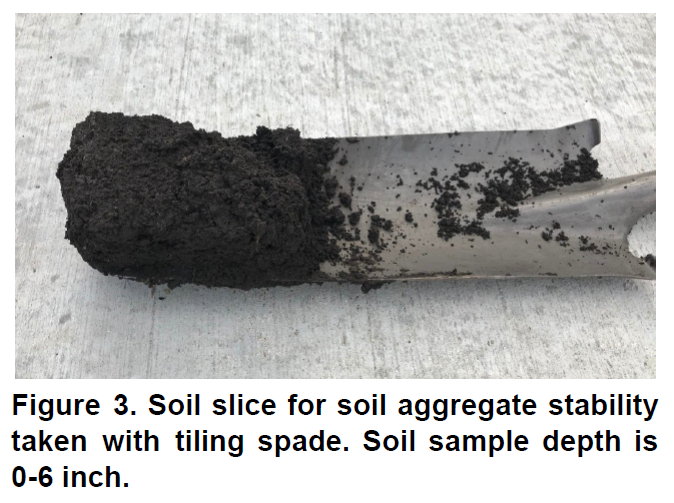
Collect an undisturbed soil slice with tiling spade or tulip bulb planter (Figure 3); this helps prevent destruction of soil aggregates. Do not collect the soil sample with a soil probe because the soil probe will destroy or compress soil aggregates. Place the soil sample in one-quart plastic bag and clearly mark with permanent marker “SOIL AGGREGATE STABILITY. DO NOT GRIND.” Like any soil health test, it is a tracking tool measuring soil quality improvement, so make sure you are using GPS-marked soil sampling points.
References
Mikha, M.M., and C.W. Rice. 2004. Tillage and manure effects on soil and aggregate-associated carbon and nitrogen. Soil Sci. Soc. Am. J. 68(3):809–816.