

Fallow Syndrome: Preventing Phosphorus Problems
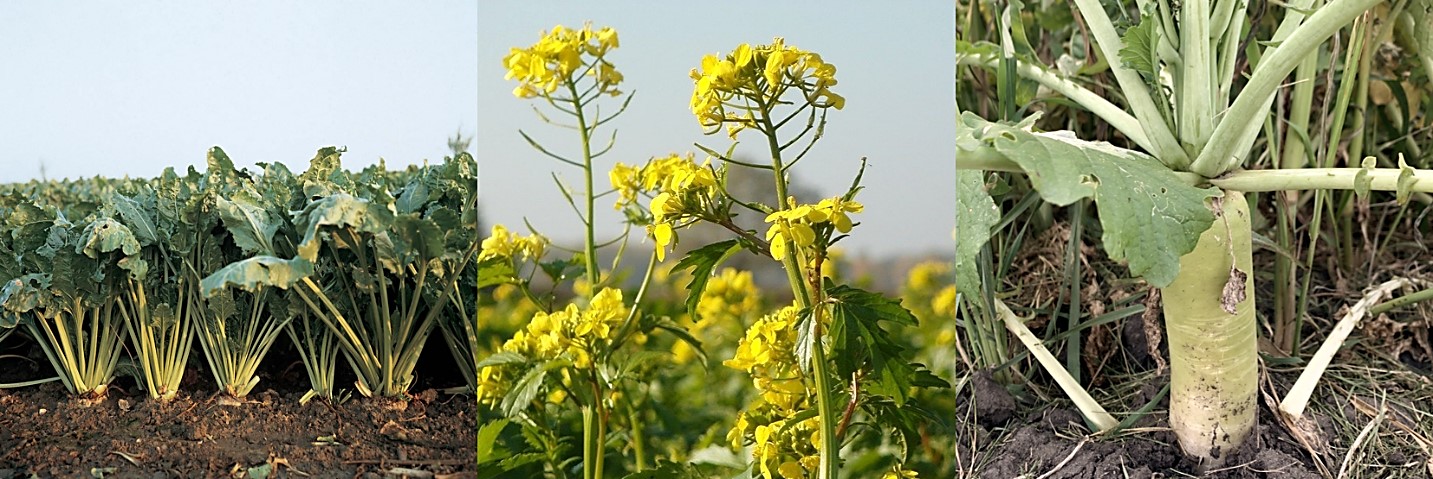
Some crops that do not support mycorrhizal fungi (left to right: sugar beet, canola, radish).
Producers in the northern Great Plains and upper Midwest need to consider the risk of fallow syndrome in their crop nutrition plans. You are probably asking, what is “fallow syndrome” and why should I care? After all, summer fallow is not that common anymore! But the greater number of Prevented Planting acres in 2019 and 2020 meant that we have had many unintended fallow fields, making fallow syndrome a serious and widespread concern for the next year.
Fallow syndrome is an induced phosphorus deficiency caused by a lack of mycorrhizal fungi in soil. Some plant species, like corn and wheat, rely heavily on mycorrhizae to colonize the plant root system and help acquire important nutrients like phosphorus and zinc. If soil is lacking sufficient mycorrhizae to colonize plant roots, a case of fallow syndrome will increase phosphorus fertilizer needs and even cost crop yield potential.
Understanding mycorrhizae
Mycorrhizae fungi occur naturally in soils and readily colonize plant roots. Upon root colonization, mycorrhizae fungal filaments act as extensions of the root system and increase the soil volume available for plant water and nutrient uptake. The combined root-mycorrhizae surface area can be up to 10-fold greater than roots without mycorrhizae. Mycorrhizae depend on living plant roots to support stable mycorrhizae populations. However, not all plant species host and support mycorrhizae growth. Some common field crops are non-host species and their planting results in rapid drops in mycorrhizae populations.
Summer fallow or unplanted cropland, such as Prevented Planting in 2020, is a classic example of providing no or few living plant roots in soil to maintain mycorrhizae populations. In addition, some crop species do not support mycorrhizae, such as those in the goosefoot family (sugar beet) and mustard family (canola, radish, turnip). Following a classic case of summer fallow or a non-mycorrhizae supporting crop, the mycorrhizae population in soil will quickly drop. A cover crop mix that included a grass species (e.g. barley, rye) should still support mycorrhizae and prevent fallow syndrome concerns.
Preventing fallow syndrome
The easiest prevention strategy after fallow is planting a crop species without fallow syndrome risk like soybean, canola, or sugar beet. Avoid planting susceptible crops like corn and wheat. These crops are highly dependent on mycorrhizae to acquire phosphorus, and extra starter phosphorus will be required if fallow syndrome risk is present.
To reduce fallow syndrome risk in corn or wheat, extra phosphorus fertilizer must be placed with or near the seed. Applying more broadcast phosphorus or relying on high soil test P will not prevent fallow syndrome. The starter phosphorus rate should be 20 to 40 lb/acre P2O5. In some university research trials, up to 60 lb/acre P2O5 with 2×2-band placement near the seed was needed to prevent corn yield loss to fallow syndrome.
For wheat, these phosphorus rates are typically seed safe with monoammonium phosphate (MAP, 11-52-0). Most corn planters can safely apply 20 lb/acre P2O5 (5 gal/acre ammonium polyphosphate, APP, 10-34-0) in the furrow. For medium/fine-textured soils with good soil moisture at planting, you can generally apply up to 10 gal/acre 10-34-0 (40 lb/acre P2O5) safely in the furrow at 30-inch row spacing. Higher 10-34-0 rates may exceed seed safety limits on dry soils or coarse-textured soils and require 2×2-band placement to maintain seed safety.
Complete liquid fertilizers, such as 6-24-6 or 9-18-9, are not suggested for preventing fallow syndrome. Compared to 10-34-0, the products have lower P concentration that result in less applied phosphorus, even if used at maximum seed safe rates. The extra N + K2O in “complete” liquid fertilizers increases the salt index and lowers the seed safe rate.