

Soybean Iron Deficiency Chlorosis: Symptoms, Causes, and Management
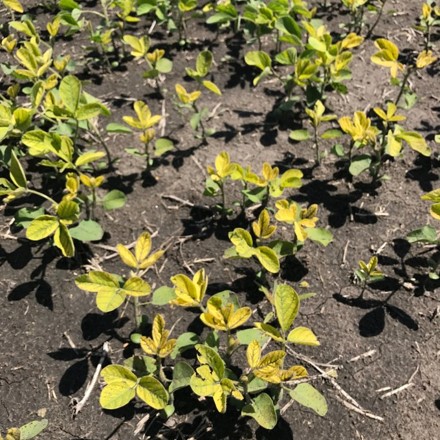
Figure 1. Soybean plants with iron deficiency chlorosis symptoms. Note the newest leaves are yellow with indistinct green veins.
If soybean turns yellow during an early growth stage, you may have a case of soybean iron deficiency chlorosis (IDC). The distinctive yellow symptoms of soybean IDC often appear as soybean enters the first- to third-trifoliate leaf stage. Soybean IDC is characterized by distinct interveinal chlorosis (yellow leaf with green leaf veins) in the newest leaves and may result in substantial yield loss (Figure 1). Soybean IDC is not caused by low soil iron but instead caused by soil conditions that decrease iron uptake by soybean roots.
Soybean IDC risk and severity are primarily related to soil carbonate content (calcium carbonate equivalent, CCE) and worsened by salinity (electrical conductivity, EC) (Table 1). Soybean IDC is common in soybean-growing regions of the upper Midwest, northern Great Plains, and Canadian Prairies, where soils frequently have high carbonate and/or salinity (Figure 2). Within a field, IDC symptoms are usually confined to soybean IDC hotspots with high carbonate and salinity; however, symptoms may appear across a field if high carbonate and salinity are present throughout the field. Soybean IDC severity is made worse in cool, wet soils and soils with high residual nitrate-nitrogen. Soil pH is not a good indicator of soybean IDC risk because some high pH soils lack high carbonate and salinity, which are the two principal risk factors.
| Table 1. Soybean iron deficiency chlorosis risk (IDC) risk potential based on soil carbonate content and salinity. | |||
| Calcium carbonate equivalent (CCE) | |||
| Salinity (EC 1:1), dS/m | less than 2.5% | 2.6 – 5.0% | greater than 5% |
| less than 0.25 | low | low | moderate |
| 0.26 – 0.50 | low | moderate | high |
| 0.51 – 1.00 | moderate | high | very high |
| greater than 1.00 | very high | very high | extreme |

Figure 2. Soil samples with high risk of soybean iron deficiency chlorosis (IDC) in the northern Great Plains and upper Midwest.
Unlike a nitrogen or sulfur deficiency, soybean IDC is not correctable with an in-season fertilizer application. Foliar application of iron fertilizers, including FeEDDHA, may have short-term cosmetic effects, but foliar iron applications have not consistently increased soybean yield on IDC-affected plants. Chlorosis symptoms often alleviate naturally as environmental conditions improve (e.g. drier, warmer weather), but severe cases can persist and cause yield loss. North Dakota State University research has shown that IDC persisting into the fifth- and sixth-trifoliate leaf stage will significantly reduce soybean yield. For fields with historical soybean IDC problems, you should delineate soybean IDC hotspots for selective management using aerial or satellite imagery.
Guidelines for managing soybean IDC
- Soil test each field, zone, or grid for soil carbonate and salinity to evaluate soybean IDC risk potential (Table 1). This may require soil sampling prior to soybean (possibly outside of your usual soil sampling rotation) or consulting previous soil sampling records.
- Plant soybean in fields with low carbonate and salinity (principal soybean IDC risk factors).
- Choose an IDC tolerant soybean variety on fields with moderate to low carbonate and salinity.
- Plant soybean in wider rows. Soybean IDC tends to be less severe in wide-row spacings (plants are closer together) than narrow-row spacings or solid-seeded spacings.
- Apply chelated iron fertilizer (e.g., high quality FeEDDHA) in-furrow at planting. In-furrow FeEDDHA application may not be enough to help an IDC susceptible variety in high IDC risk soils (Figure 3).
- Avoid planting soybean on soils with very high IDC risk.
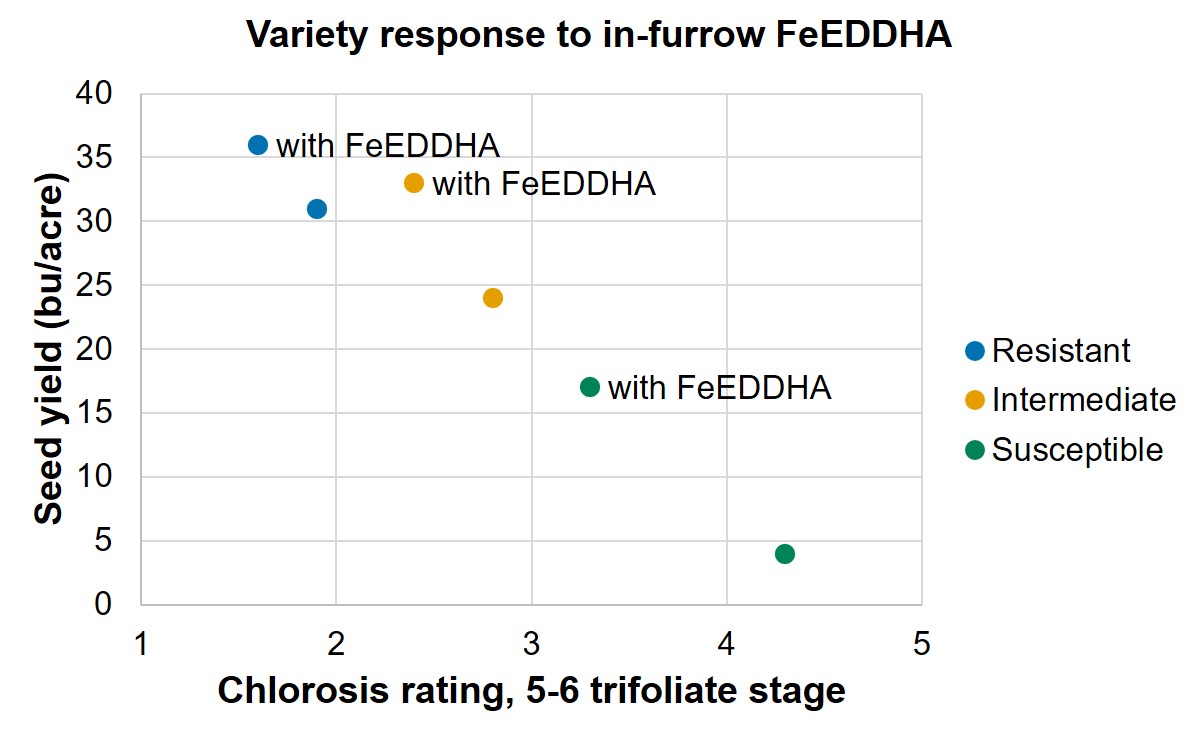
Figure 3. Soybean iron deficiency chlorosis (IDC) severity is reduced with iron fertilization. However, IDC-tolerant soybean varieties are more effective. Research from Dr. R. Jay Goos, NDSU, 2000.