
Sodic Soil Problems? Try the NDSU Gypsum Requirement Calculator

This article originally appeared in the AGVISE Laboratories Spring 2025 Newsletter.

Salinity and sodicity are two related but distinct terms to describe salt-affected soils. Salinity is the overall abundance of soluble salts, which compete with plant water uptake and reduce crop productivity. Salinity is measured as soluble salts (mmhos/cm or dS/m) on soil test reports. Sodicity specifically refers to high sodium in soil that destroys soil structure, resulting in poor water movement, poor trafficability, and soil compaction. Sodicity is measured as extractable sodium percentage (%Na) or sodium adsorption ratio (SAR) on soil test reports.

Saline soils have an overall abundance of soluble salts, which must be managed with salt-tolerant plant species or improved soil water management (tile drainage). There is nothing you can add to make the salts disappear, such as the mistaken suggestion to apply gypsum to saline soils. Gypsum, however, can be an effective amendment for sodic soils (those with low salinity yet high sodium). A soluble calcium source, like gypsum, can help reduce soil swelling and dispersion and help improve soil structure and water movement on troublesome sodic soils.

The amount of gypsum required is often in tons per acre. This is no task accomplished with a few hundred pounds of gypsum. To calculate the amount of gypsum needed, North Dakota State University has released a gypsum requirement calculator, available online: https://www.ndsu.edu/pubweb/soils/GypsumRequirementWebApp/ The calculator will ask for the soil depth to amend, soil bulk density, CEC, gypsum purity, and initial/target SAR values.

AGVISE Demonstration Project: Lowering Soil pH with Elemental Sulfur

This article originally appeared in the AGVISE Laboratories Spring 2025 Newsletter.

There may not be silly questions, but there are silly answers. Every so often, we get questions about unusual solutions to manage calcareous soils in the northern Great Plains and Canadian Prairies. The most frequent oddball “solutions” involve lowering soil pH with elemental sulfur on calcareous soils. Such suggestions might work on acidic soils; however, the dominant calcareous soils in the region have high pH (>7.3) and tons of natural calcium carbonate that make such attempts impractical and expensive. To put the nail in the coffin, AGVISE Laboratories started some long-term demonstration projects to show plainly why such ideas do not work or may cost way too much!

If possible, we’d like an easy and cheap solution to lower soil pH, like applying only 100 to 200 lb/acre elemental sulfur (S). In soil, elemental S oxidizes to sulfuric acid, which can lower soil pH. However, the large amount of calcium carbonate (free lime) keeps our soils buffered at high pH. To lower soil pH permanently, you must first react and neutralize the carbonate with elemental S before the soil pH can budge. With 100 lb/acre elemental S applied each year, that does not sound too difficult, right?

Elemental sulfur project with rates ranging from 0 to 40,000 lb/acre elemental sulfur. Can you identify the 20 ton/acre rate?

Not so fast. A soil with only 1% calcium carbonate equivalent (CCE) takes 3.2 ton/acre elemental S (6,400 lb/acre) to neutralize the carbonate alone in the 0-6 inch soil depth. In 2020, we started an elemental S project at Northwood, ND on soil containing 4.5% CCE, which would require literal tons of elemental S to lower soil pH. A previous project started in 2005 had used 10,000 lb/acre elemental S, but it was not enough to lower soil pH beyond pH 7.8 after 15 years. This time, we decided to get serious and use elemental S rates from 0 to 40,000 lb/acre (Figure 1). The elemental S rates were intended to hit above and below the target 30,000 lb/acre elemental S rate required to react and neutralize 4.5% CCE.

For the first three years of the project, we saw little to no change in soil pH, regardless of elemental S rate. The oxidation process that converts elemental S to sulfuric acid is a slow, biological process that can take a long time. In Fall 2024, we finally saw real changes in soil pH following elemental S application. The 16,000 lb/acre elemental sulfur rate reached pH 7.5. The 24,000 lb/acre elemental sulfur rate reached pH 7.0. The 40,000 lb/acre elemental sulfur rate reached pH 6.0, a dramatic change! The lowest 8,000 lb/acre elemental sulfur rate, however, was no different than the control.

There is still some unoxidized elemental sulfur and unreacted calcium carbonate in the soil, and we will continue to monitor these long-term demonstration plots in future years. The project demonstrates that elemental sulfur can lower soil pH, but it also shows that the very high amounts of elemental sulfur required are both impractical and expensive. A few hundred pounds of elemental sulfur applied each year will get you nowhere. In contrast, the very high elemental sulfur rates will break the bank. This is why we consider such “solutions” as either ineffective attempts or downright silly wastes.

Lime Works: The Results Are In

This article was originally published in the AGVISE Laboratories Winter 2023 Newsletter.

In the fall of 2022, I hired a custom applicator to haul and spread lime across 238 acres of my family’s farm in western North Dakota. The reason? To increase soil pH on five fields with very low soil pH. One field even had a soil pH of 4.7, so these were good candidate fields for a practical case study for liming on a real farm operation.

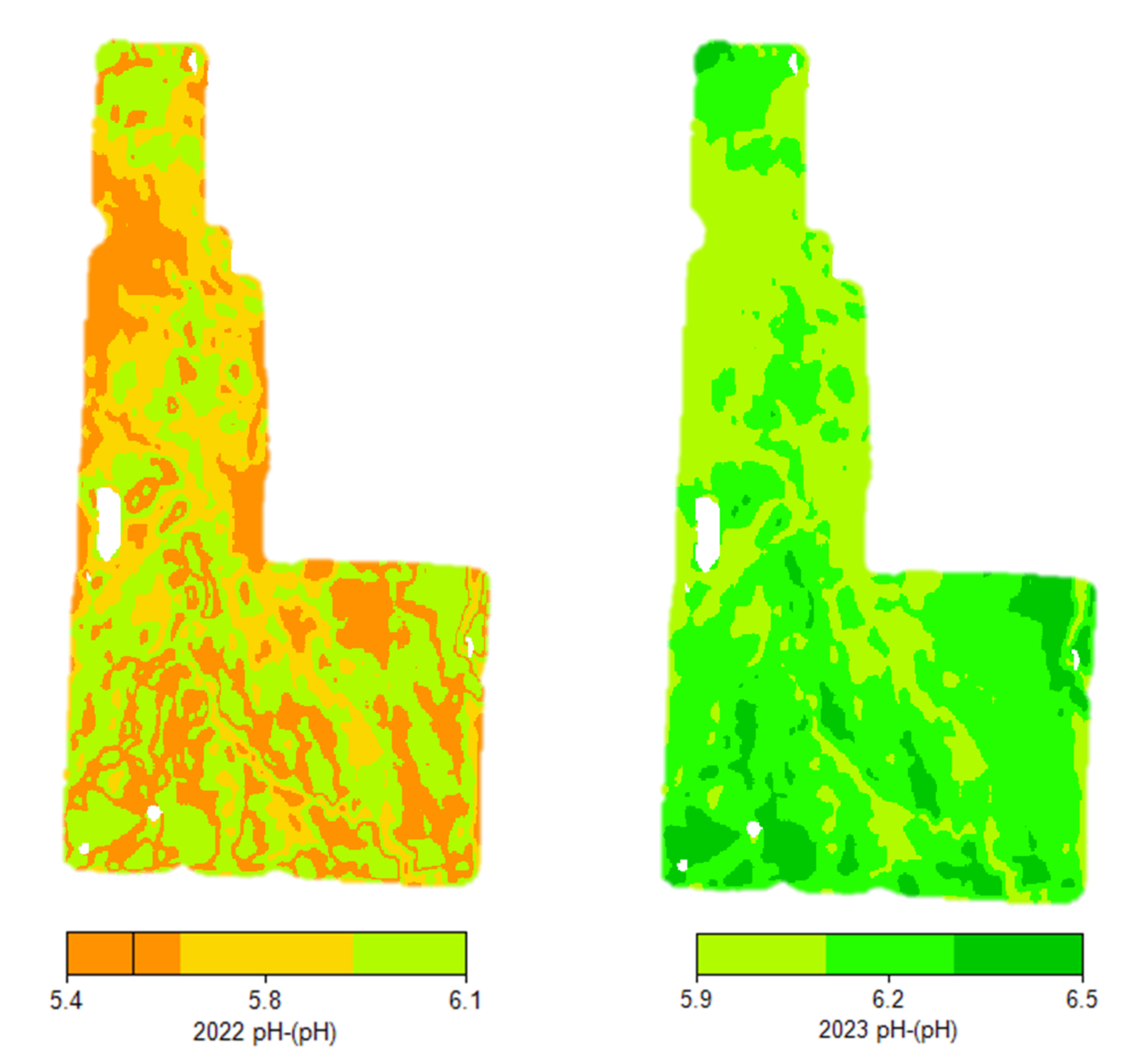
I wrote more about the soil sampling process and lime application in the AGVISE Winter 2022 newsletter (https://www.agvise.com/wp-content/uploads/2022/11/AGVISE-Newsletter-2022-Winter.pdf). Each field received approximately 2 ton/acre sugar beet lime (1.4 ton ENP/acre) from Sidney Sugar in Sidney, MT, and the lime was disced to 3 inches for incorporation. After one year, the soil pH had already increased by 0.36 pH-units in the 0-6 inch soil depth. The 2023 growing season was relatively wet in southwest North Dakota, and the additional soil water certainly helped the lime react and neutralize soil acidity quickly. The incorporation with a disc also helped distribute the lime more evenly and deeply, allowing the lime to react faster. One negative side effect of tillage was a flush of annual weeds, particularly green and yellow foxtail. This was the first tillage event on these fields in 12 years, so I expect the annual weed community to diminish as we return to no-till after the one-time tillage pass.

Figure 1. Zone soil pH map of a field receiving 2 ton/acre sugar beet lime in fall 2022. Each zone increased roughly 0.36 pH-units from 2022 to 2023. (Maps created in ADMS 32, GK Technology, Inc.)

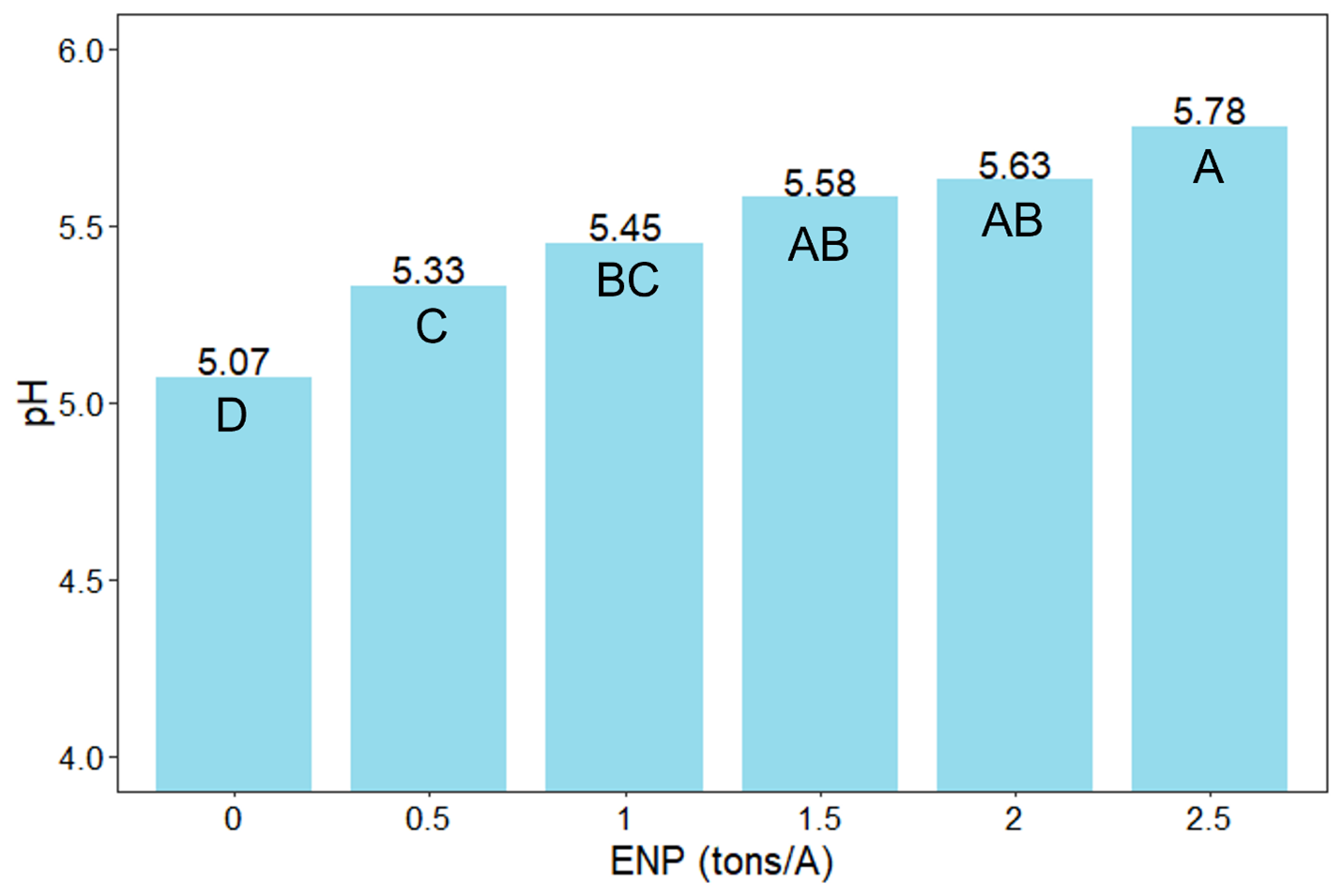
Lime also works without incorporation, just at a slower pace. In 2021, we established a no-till lime trial to investigate lime rates without incorporation. Lime was applied in May 2021, and the fall 2023 soil pH results are shown in Figure 2. The highest lime rate at 2.5 ton ENP/acre increased soil pH in the upper 0-3 inch soil depth by 0.71 pH-units over 2.5 years. So far, no effect on soil pH in the lower 3-6 inch soil depth has been observed. In most no-till systems, the most acidic part of the soil profile is located at the soil surface, and a lime application correcting soil pH in the upper 0-3 inch soil depth is still effective. This is where seedlings and roots are most vulnerable to soil acidity, so correcting soil pH at the soil surface is critical and can be accomplished with a surface application of lime in no-till systems.

Surface Soil pH (0-3 inch) in No-till Lime Trial, October 2023

Figure 2. Soil pH following surface application of lime after 2.5 years in a no-till cropping system in southwestern North Dakota.

Adjusting high soil pH and salinity with sugar beet-processing spent lime

The sugar beet processing industry uses large quantities of fine-ground, high-grade calcium carbonate (lime) to purify sucrose in the sugar extraction process. The by-product spent lime retains high reactivity and purity, making it an attractive liming material for acidic soils. Application of spent lime is a common practice through the sugar beet producing areas of the upper Midwest and northern Great Plains, where its primary function is the suppression of the soil-borne disease Aphanomyces root rot of sugar beet. The spent lime also contains about 20 lb P2O5 per ton, mostly as organic phosphorus impurities gained from sugar refining.

We often get questions about correcting high soil pH and salinity with spent lime. Salt-affected soils, saline and sodic, are a common problem across the northern Great Plains. These soils have high soil pH and present numerous agronomic and soil management problems. The soil amendment gypsum (calcium sulfate) is often applied to sodic soils (those with high sodium) to combat soil swelling and dispersion. The spent lime (calcium carbonate) also contains calcium, but it is very insoluble at high soil pH.

Each year, we get many questions about applying spent lime on soils with high pH and salinity. To answer these questions, AGVISE Laboratories installed a long-term demonstration project in 2008 to evaluate adjusting high soil pH and salinity with spent lime. We applied multiple spent lime rates and tracked soil test levels over seven years. There were no significant changes or trends in soil pH (Table 1) or salinity (Table 2). This is no surprise because the initial soil pH was high and buffered around 7.8-8.2, indicating the presence of natural calcium carbonate. If the soil already contains naturally occurring lime, what is the good of adding more lime? Moreover, calcium carbonate is very insoluble, so there is no expectation that more lime will decrease or increase salinity.

Since soil test levels did not change over seven years, we terminated the project in 2014. The research question was a conclusive dud. While spent lime is useful to amend acidic soils and suppress Aphanomyces root rot of sugar beet, it does not help on soils with high pH or salinity.


Table 1. Soil pH (1:1) following sugar beet-processing spent lime application on high pH soil.
Spent Lime Year Average
2008 2009 2010 2011 2012 2013 2014
ton/acre
1 7.8 7.7 7.9 7.8 7.7 8.0 8.0 7.80
2 7.9 7.9 8.1 7.9 7.9 8.0 8.0 7.94
3 7.9 7.9 8.1 7.9 7.9 8.1 8.1 7.95
4 7.8 7.8 7.9 7.7 7.8 8.1 8.0 7.85
5 7.8 7.8 8.0 7.9 7.9 8.0 8.0 7.90
6 8.0 7.9 8.2 8.0 8.0 8.1 8.1 8.00
Spent lime applied and incorporated September 2008. Soil sampled in fall.


Table 2. Soil salinity (electrical conductivity, EC 1:1) following sugar beet-processing spent lime application on moderately saline soil.
Spent Lime Year
2008 2009 2010 2011 2012 2013 2014
ton/acre ——————— dS/m ———————
1 1.5 1.2 1.8 1.1 1.6 1.2 1.8
2 1.9 2.1 2.3 2.5 2.3 2.0 2.0
3 1.9 2.2 2.6 2.5 2.4 1.9 1.9
4 1.0 1.3 1.4 1.2 1.5 1.9 1.9
5 1.7 2.2 2.2 2.3 2.2 1.7 1.7
6 2.6 2.1 2.1 2.9 2.5 1.9 1.9
Spent lime applied and incorporated September 2008. Soil sampled in fall.

Adjusting low soil pH with sugar beet-processing spent lime

The sugar beet processing industry uses large quantities of fine-ground, high-grade calcium carbonate (lime) to purify sucrose in the sugar extraction process. The by-product spent lime retains high reactivity and purity, making an attractive liming material for acidic soils. Application of spent lime is a common practice through the sugar beet producing areas of the upper Midwest and northern Great Plains, where its primary function is the suppression of the soil-borne disease Aphanomyces root rot of sugar beet. The spent lime also contains about 20 lb P2O5 per ton, mostly as organic phosphorus impurities gained from sugar refining.

AGVISE Laboratories installed a long-term demonstration project in 2014 to evaluate adjusting low soil pH with spent lime. The project site was located near our Northwood Laboratory. Northwood lies along the beachline of glacial Lake Agassiz, where well-drained coarse-textured soils with low pH are common. We located a very acidic soil with soil pH 4.7 (0-6 inch), which was the perfect site to evaluate lime application. In May 2014, spent lime was applied and incorporated with rototiller. The spent lime quality was very high at 1,500 lb ENP/ton. In Minnesota, lime quality is measured as effective neutralizing power (ENP), which measures lime purity and fineness. Soil pH was tracked over three years (Table 1).

The lowest spent lime rate (2,500 lb ENP/acre) increased soil pH above 5.5. This soil pH reduced aluminum toxicity risk, but it did not reach the target pH 6.0, appropriate for corn-soybean rotation. The highest spent lime rate (10,000 lb ENP/acre) increased soil pH above 7.0 and maintained soil pH for several years. Spent lime is a fine-ground material with high reactivity, so its full effects were seen in the first application year. The project showed that spent lime is an effective liming material for low pH soils.

Table 1. Soil pH (1:1) following sugar beet-processing spent lime application on low pH soil.
Spent Lime Year
May 2014 Sept 2014 July 2015 June 2016
lb ENP/acre
0 4.8 4.8 4.7 5.1
2,500 4.8 5.5 5.2 5.4
5,000 4.8 5.6 5.7 5.5
10,000 4.8 7.4 7.0 7.4
Spent lime applied and incorporated September 2008. Soil sampled in fall.

Adjusting high soil pH with elemental sulfur

Soil pH is a soil chemical property that measures soil acidity or alkalinity, and it affects many soil chemical and biological activities. Soils with high pH can reduce the availability of certain nutrients, such as phosphorus and zinc. Soils of the northern Great Plains and Canadian Prairies often have high soil pH (>7.3) and contain calcium carbonate (free lime) at or near the soil surface. It is the calcium carbonate in soil that maintains high soil pH and keeps it buffered around pH 8.0. The calcium carbonate originates from soil formation processes since the latest glacial period.

An unfounded soil management suggestion is that soil pH can be successfully reduced by applying moderate rates of elemental sulfur (about 100 to 200 lb/acre elemental S). Elemental sulfur must go through a transformation process called oxidation, converting elemental sulfur (S0) to sulfuric acid (H2SO4), a strong acid. Sulfuric acid does lower soil pH, but the problem is the amount of carbonate in the northern region, which commonly ranges from 1 to 5% CCE and sometimes over 10% CCE. Soils containing carbonate (pH >7.3) will require A LOT of elemental sulfur to neutralize carbonate before it can reduce soil pH.

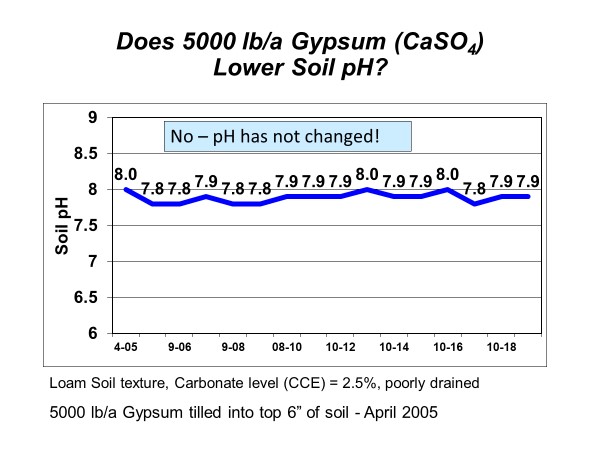
To lower pH in soils containing carbonate, the naturally-occurring carbonate must first be neutralized by sulfuric acid generated from elemental sulfur. You can visualize the fizz that takes place when you pour acid on a soil with carbonate. That fizz is the acid reacting with calcium carbonate to produce carbon dioxide (CO2) gas. Once all calcium carbonate in soil has been neutralized by sulfuric acid, only then can the soil pH be lowered permanently. It is important to note that sulfate-sulfur sources, such as gypsum (calcium sulfate, CaSO4), do not create sulfuric acid when they react with soil, so they cannot neutralize calcium carbonate or change soil pH (Figure 1).

Figure 1. Soil pH following gypsum application on soil with high pH and calcium carbonate.

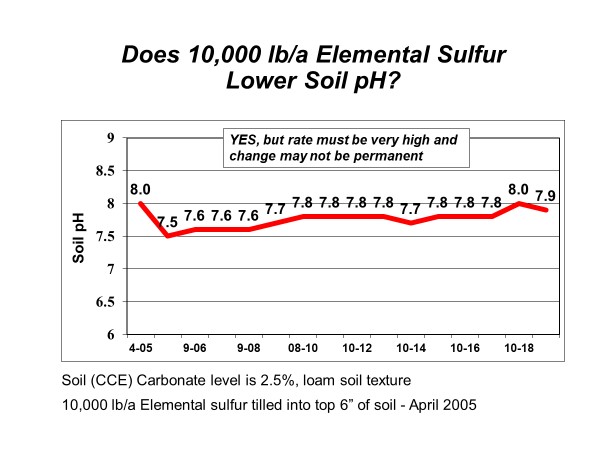
In 2005, AGVISE Laboratories installed a long-term demonstration project evaluating elemental sulfur and gypsum on a soil with pH 8.0 and 2.5% calcium carbonate equivalent (CCE). The highest elemental sulfur rate was 10,000 lb/acre (yes, 5 ton/acre)! We chose such a high rate because the soil would require a lot of elemental sulfur to neutralize all calcium carbonate. Good science tells us that 10,000 lb/acre elemental sulfur should decrease soil pH temporarily, but it is still not enough to lower soil pH permanently. In fact, this is exactly what we saw (Figure 2). Soil pH declined in the first year, but it returned to the initial pH over subsequent years because the amount of elemental sulfur was not enough to neutralize all calcium carbonate.

Figure 2. Soil pH following elemental sulfur application on soil with high pH and calcium carbonate.

A quick calculation showed that the soil with 2.5% CCE would require about 16,000 lb/acre elemental sulfur to neutralize all calcium carbonate in the topsoil. Such high rates of elemental sulfur are both impractical and expensive on soils in the northern Great Plains. The only thing to gained is a large bill for elemental sulfur. While high soil pH does lower availability of phosphorus and zinc, you can overcome these limitations with banded phosphorus fertilizer and chelated zinc on sensitive crops. All in all, high soil pH is manageable with the appropriate strategy. That strategy does not involve elemental sulfur.