
Soil Science Review: Organic Matter

Soil organic matter is a fundamental component of soil. It is comprised of living microorganisms, recently decomposed plant material, and stable humus organic compounds. Soil organic matter influences numerous biological, chemical, and physical properties of soil. It influences soil structure, water holding capacity, nutrient cycling, biological activity, and chemical fate and transport (e.g. pesticides). Soil organic matter is so important, you cannot really call something soil unless there is some organic matter present.

In the laboratory, soil organic matter can be measured via three different methods: Walkley-Black wet oxidation, estimation from organic carbon dry combustion, or loss-on-ignition (LOI) dry combustion. Each method has advantages and disadvantages. The LOI method is the routine method in commercial soil analysis.

Walkley-Black Wet Oxidation

The Walkley-Black wet oxidation method is the classic soil organic matter method developed in 1934. The method measures easily oxidizable carbon using sulfuric acid and potassium dichromate. The Walkley-Black method works very well on soils with low organic matter (<2.0%); however, the method is less suitable on soils with very high organic matter (>8.0%) as the dichromate reagent is consumed and may not oxidize all organic carbon. Soils with high chloride may interfere with the Walkley-Black method.

The Walkley-Black method has been phased out since the 1980s because the method requires hazardous chemicals and additional labor; therefore, the Walkley-Black method is more expensive than other methods. As the standard method, it is still required for some pesticide registration studies and regulatory soil characterization work.

Estimation from Organic Carbon Dry Combustion

Soil organic matter is a large complex organic compound containing hydrogen, oxygen, carbon, nitrogen, phosphorus, sulfur, and other elements. Soil organic matter contains about 58% organic carbon on average. We can estimate soil organic matter content from the amount of organic carbon measured in soil. Soil organic carbon is easily measured using a dry combustion carbon analyzer. The analyzer heats soil at high temperature to oxidize all carbon as carbon dioxide, which is then measured with an infrared detector. Since the method requires specialized instrumentation, it is more expensive than the LOI method.

The organic carbon dry combustion method is preferred in carbon sequestration research because organic carbon is measured directly. Estimating organic carbon from Walkley-Black or loss-on-ignition methods introduces unneeded calculation error.

For calcareous soils (pH > 7.3), inorganic carbon (carbonate) must also be analyzed. The dry combustion carbon analyzer measures total carbon, which combines inorganic and organic carbon. The inorganic carbon is measured separately, then subtracted from total carbon to calculate organic carbon.

Loss-on-Ignition Dry Combustion

The loss-on-ignition (LOI) dry combustion method is the routine soil organic matter method used in commercial soil analysis. The amount of soil organic matter is measured directly as the weight loss upon combustion at 360 deg C. The LOI method is simple, affordable, and safe. It also requires no hazardous chemicals. The method works well on soils with high organic matter content since there is no consumable reagent (like Walkley-Black method).

For soils containing hydrated salts (e.g. gypsum, CaSO4∙2H2O; Epsom salt, MgSO4∙7H2O), the LOI method may overestimate soil organic matter upon loss of water from hydrated salts. Soil is preheated at 105 deg C to remove structural water from clay minerals and hydrated salts, but some hydrated salts may retain water above the 105 deg C preheating process.


Soil organic matter affects various soil properties and processes. In return, various soil properties and soil formation factors affect soil organic matter.

Soil Texture

Soil clay particles protect soil organic matter from microbial decomposition (i.e. formation of protective clay-humus complexes). Soils with more clay generally have greater soil organic matter. In addition, soils with more clay also can store more plant available water, so plant biomass production and organic material addition to soil is greater.

Cation Exchange Capacity

Cation exchange capacity is derived from negative-charged soil particles, like clay minerals and soil organic matter. Soils with more soil organic matter will have higher cation exchange capacity.

Bulk Density

Bulk density is the amount of soil mass per unit volume. Soils with high bulk density may be compacted, which can inhibit plant root growth and exploration of the entire soil volume. A compacted soil also has less open pore space for air and water storage and movement in soil. Soil organic matter has low particle density, and it helps alleviate soil compaction and high bulk density. Soils with low bulk density likely contain high soil organic matter.

Water Holding Capacity

The amount of soil organic matter in soil is closely associated with soil texture and bulk density. The association also extends to water holding capacity. Like clay particles, soil organic matter has a lot of surface area on which water films can adhere, thus increasing the water holding capacity. Soils with more soil organic matter will hold more plant available water than soils with low organic matter.

Soil pH

Soil microorganisms breakdown soil organic matter into its constituent nutrient components; this is called nutrient cycling. The type and species of soil microorganism present depend on soil pH. In neutral to alkaline soils, the soil microorganism community is comprised of diverse bacteria and fungi to decompose soil organic matter. In acidic soils, the soil microorganism community is mostly fungi, so decomposition processes occur slower. In acidic soils, soil organic matter accumulates faster, producing soils with high soil organic matter. Soils with very alkaline pH also have reduced soil microorganisms activity and decomposition rates.

Soil Microorganism Biomass

Soil organic matter is the primary carbon food source for soil microorganisms. To maintain a high amount of soil microorganism biomass and biological activity, a significant amount of soil organic matter is required. Soils with low organic matter generally have reduced biological activity.

Soil Science Review: Cation Exchange Capacity

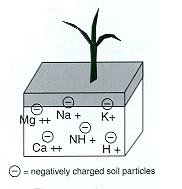
Each year, AGVISE Laboratories delivers thousands of soil characterization reports with something printed on them called, “Cation Exchange Capacity (CEC).” Unless you have some background in soil science or surface chemistry, the number might be a mystery to you. Cation exchange capacity is the amount of positive-charged cations (e.g. ammonium, calcium, hydrogen, magnesium, potassium, sodium) held on negative-charged soil particles, like clay and organic matter.

Let’s start with the basics. Elements and compounds in soil usually exist as ions, which have either positive or negative charge. The positive ions are called cations. Some common positive-charged cations are calcium, magnesium, potassium, and sodium.

Soil particles have negative charge on their surfaces and edges. Since soil particles have negative charge and the cations have positive charge, the two are attracted together like magnets. If the positive-charged cations are held on the negative-charged soil particles, then the ion cannot leach through the soil profile with soil water. Therefore, the amount of positive-charged cations that are held on negative-charged soil particles is the cation exchange capacity (CEC). The CEC reporting units are centimole of charge per 1 kilogram soil (cmolc/kg) or milliequivalent per 100 gram soil (meq/100 g). The units are numerically equivalent, so a soil with CEC 20 cmolc/kg is equal to 20 meq/100 g.

Soils with high CEC are generally more fertile and can provide plants with more nutrients and water. A soil with high CEC (>25 cmolc/kg) can hold many cation nutrients and likely contains a high amount of clay and/or organic matter. A soil with low CEC (<5 cmolc/kg) cannot hold many cation nutrients, and it is likely sandy with little organic matter.

The CEC measurement can also provide information about the fate and transport of other charged compounds in the soil solution, like pesticides. Pesticides with positive charge are bound more tightly to soil particles if CEC is high. Sandy soils with low CEC often cannot hold onto positive-charged pesticides, meaning that pesticide may be prone to leaching.

There are different laboratory methods to measure CEC of soil. The most common method in commercial soil testing is the summation method, where all extractable cations on soil particles are summed together. The cations are extracted with ammonium acetate, then analyzed with atomic absorption spectroscopy (AAS) or inductively coupled plasma atomic emission spectroscopy (ICP-AES). The extracted cations are then added together to calculate CEC. The routine method works well on most soils; however, it does not do work well on soils with salinity or calcium carbonate (pH > 7.3). The ammonium acetate extraction also dissolves cations contained in soluble salts and calcium carbonate minerals. These cations are not held on cation exchange sites (i.e. cation exchange capacity), but they are still included in the CEC measurement, creating an inflated and inaccurate CEC result.

To obtain accurate CEC results on soils with salinity or calcium carbonate, the saturation-displacement CEC method is appropriate. The method first saturates all cation exchange sites with one cation (either ammonium or sodium) and washes away all other cations. The second step displaces the target cation to obtain the accurate CEC measurement. The saturation-displacement CEC method involves more work and cost than the routine summation method. You should talk with a soil scientist to help you decide which laboratory method is required to obtain an accurate CEC result.

Molybdenum: The Micro-est of Micronutrients

Molybdenum (Mo) is an essential plant nutrient, necessary for nitrate assimilation and biological nitrogen fixation. Legumes, relying on symbiotic nitrogen fixation, have greater Mo requirement than non-legumes. Nevertheless, the Mo requirement of plants is the lowest among all micronutrients, with critical deficiency concentrations ranging from 0.1 to 1.0 ppm in plant leaves. The very low Mo concentration lies near the detection limit for most laboratory instruments used in commercial soil and plant analysis, so you may see Mo concentration reported as “below instrument detection limit.”

Plant-available Mo in soil is present as molybdate (MoO42-). Unlike most other micronutrients, molybdate availability in soil increases with soil pH. On soils with pH greater than 6.0, Mo deficiency is exceptionally rare. In the northern Great Plains and Canadian Prairies where most soils have high pH, Mo deficiency is virtually unknown, and background plant Mo concentration in legumes ranges from 4 to 8 ppm, indicating that plants obtain sufficient Mo from soil naturally. In the upper Midwest where low pH soils are more common, crop response to Mo fertilization has been limited to legume crops grown on strongly acidic, sandy or peat soils.

Since Mo deficiency is so uncommon and most soils are limed above pH 6.0, no reliable plant-available soil test method for Mo has been developed in the region. The acid ammonium oxalate method was infrequently used in the southeast United States, but the prediction of crop response to Mo fertilization aligns more closely with soil pH than soil test Mo. If soil pH is less than 6.0 and Mo fertilization is necessary, a molybdate fertilizer seed treatment or foliar application is usually sufficient. Overapplication of Mo fertilizer is not a concern for grain production. In forage production however, overapplication is a serious concern because excessive Mo in forages can cause Mo-induced copper deficiency (molybdenosis) in ruminant livestock.

5 Things You Should Know About Phosphorus

1. The two accepted soil phosphorus tests in the North Central Region are the Olsen and Bray-P1 methods

The Olsen (bicarbonate) method is the standard soil P test in the North Central region. This method was developed to work on soils with low and high pH. The Olsen method works well in precision soil sampling, where the same field may have zones with acidic and calcareous soils. The Bray P-1 method is another accepted method in our region, but not always recommended. This method was developed in the U.S. Corn Belt, has a long history of soil test calibration studies and works well on acidic soils. The Bray P-1 method fails on soils with pH greater than 7, producing results with false low soil test P. Therefore, it has remained limited to the U.S. Corn Belt proper. The Mehlich-3 method was introduced as a multi-nutrient soil extractant. But like the Bray P-1 method, the acidic Mehlich-3 method does not perform well on calcareous soils; therefore, it has not gained approval by universities in the northern Great Plains and Canadian Prairies.

All soil P test methods are designed to predict the probability of crop response to P fertilization. The methods measure the plant-available P pool. Since the soil test method is an index of availability, the units are reported in parts per million (ppm) and ranked low, medium, or high based on university soil test calibration research. No soil P test method measures the actual pounds of available P in soil, they are only indexes of crop response.

 2. Most soils in the Northern Plains/Canadian Prairies region could use more phosphorus

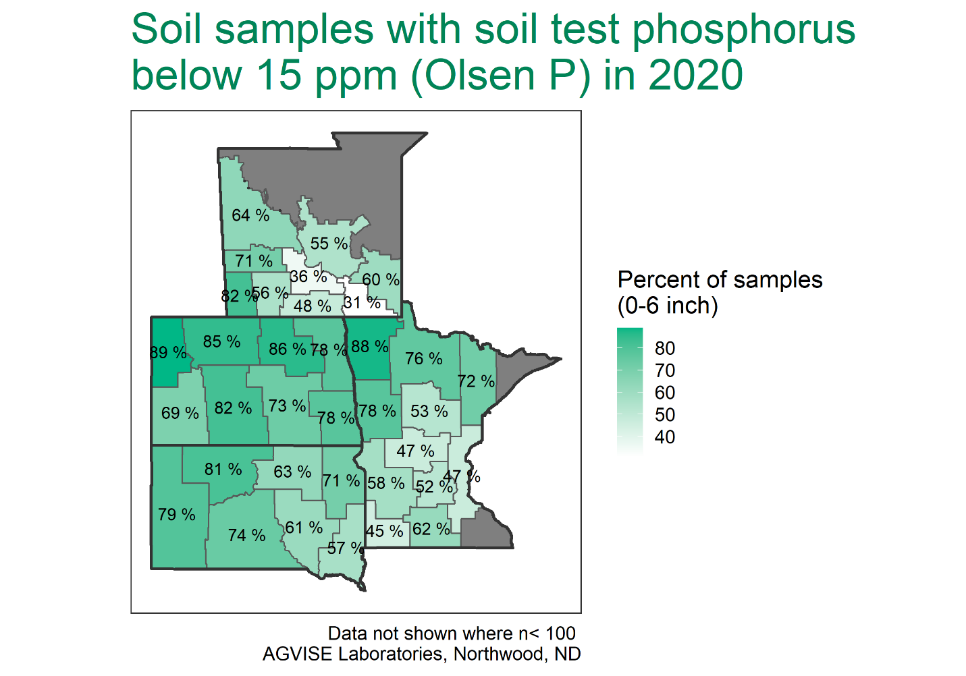
Soils in the region are naturally low in P and historical P fertilizer use has been low, relative to crop P removal. As a result, many areas in the region still have low soil test P (below soil test critical level of 15 ppm Olsen P) after many decades of crop production. In other words, most farmers are not over-applying P. In fact, soils with low soil test P should receive moderate to high rates of fertilizer P each year to achieve good crop yield and maximize profitability.

Figure 1. Map developed using AGVISE soil test data. AGVISE has created regional summaries like this for the past 40 years. Check out the summary data for Montana and Canada and summaries of other nutrients and soil properties here.

3. You should use starter phosphorus fertilizer

Starter fertilizer placed near, or with the seed, is critical for crops like corn and wheat, regardless of soil test P level. A P fertilizer band placed near the seed will ensure soluble P near developing plant roots and results in vigorous early season growth, which is important in cold, wet soil conditions. Placing P fertilizer in bands also improves P use efficiency, especially in soils with relatively low or high pH. Phosphorus availability is greatest near soil pH 6.5. Since changing soil pH is difficult and costly, fertilizer P use efficiency is more easily improved with application in fertilizer bands to reduce the volume of soil involved in P fixation reactions.

4. Phosphorus source doesn’t really matter

No matter the starting material, all P fertilizers go through the same chemical reactions in the soil. It does not matter if the fertilizer starts as a poly-phosphate or ortho-phosphate. Within about one week in the soil, all P fertilizer sources react to form lower solubility compounds. What is more important than source is the placement of the fertilizer to increase availability (banding) and the rate of actual P fertilizer applied.

5. Phosphorus can be an environmental concern

Phosphorus entering surface waters can create algae blooms and fish kills. Since P is not mobile in soil, the P leaching risk is very low. However, P does move to surface waters with soil particles when erosion occurs. In cold climates like those on the northern Great Plains and Canadian Prairies, dissolved P released from vegetation can move with snow melt to surface water.

For more information about phosphorus and its reactions in soil, explore the links below:

Understanding Phosphorus in Minnesota Soils (Univ. Minnesota)

Understanding Plant Nutrients: Soil and Applied Phosphorus (Univ. Wisconsin)

Phosphorus Facts: Soil, plant, and fertilizer (Kansas State Univ.)


5 Things You Should Know About Calcium

1. Calcium (Ca) is abundant in soils of the upper Midwest, northern Great Plains, and Canadian Prairies; calcium deficiency in agronomic crops is rare

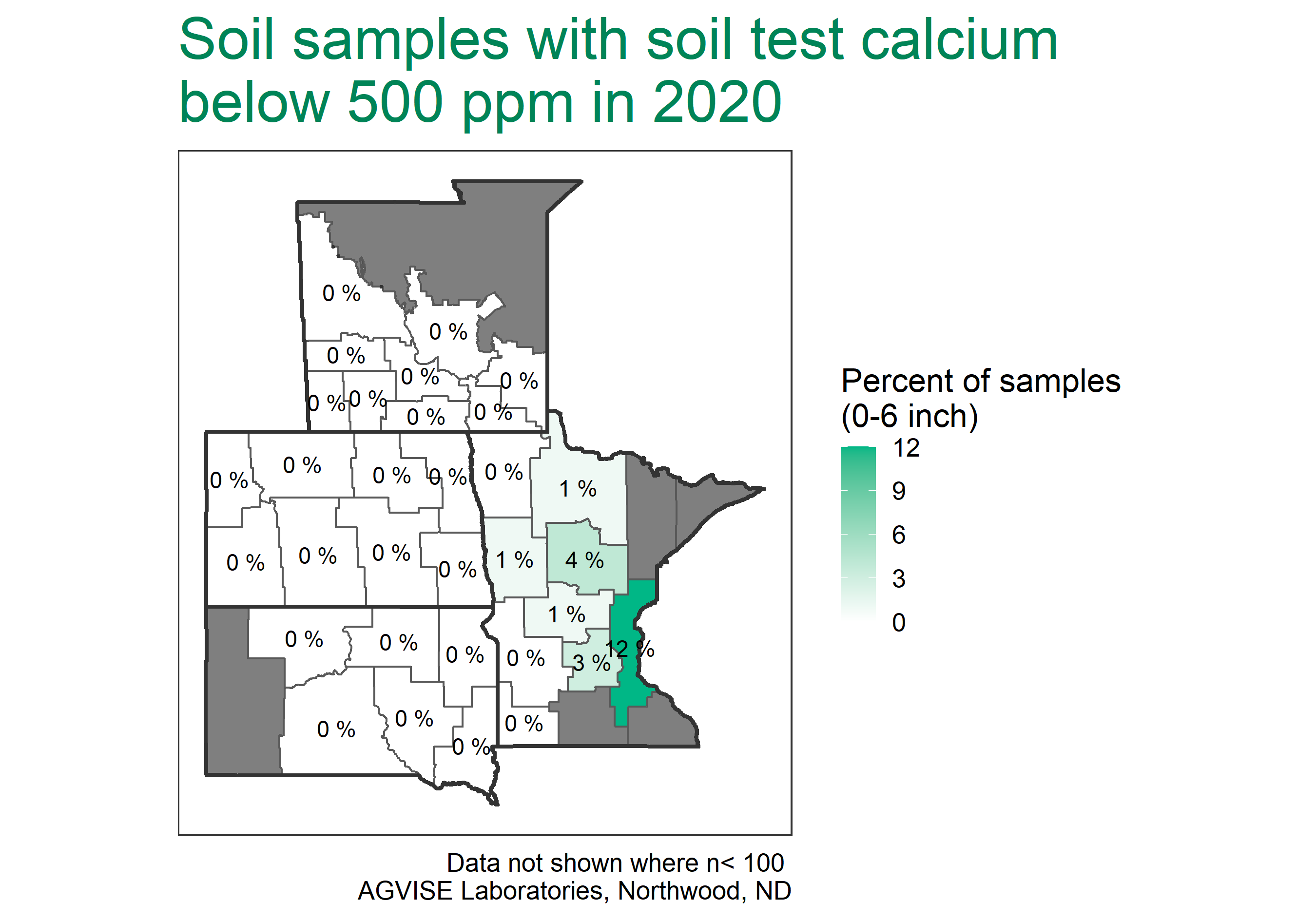
Calcium makes up about 3.6% of the Earth’s crust, and it is relatively abundant in agricultural soils across the region. In soils with pH greater than 6.0, Ca is the dominant cation (positively charged ion) on the cation exchange capacity (CEC). Since most soils in the region have a pH of 6.0 or above, calcium is very abundant and soils with low soil test Ca (less than 500 ppm) are rare (Figure 1).

Soil samples with soil test calcium below 500 ppm in 2020

Figure 1. AGVISE regional soil test summary. AGVISE has created regional summaries for the past 40 years. You can find more soil test summary data, including Montana and Canada, here.

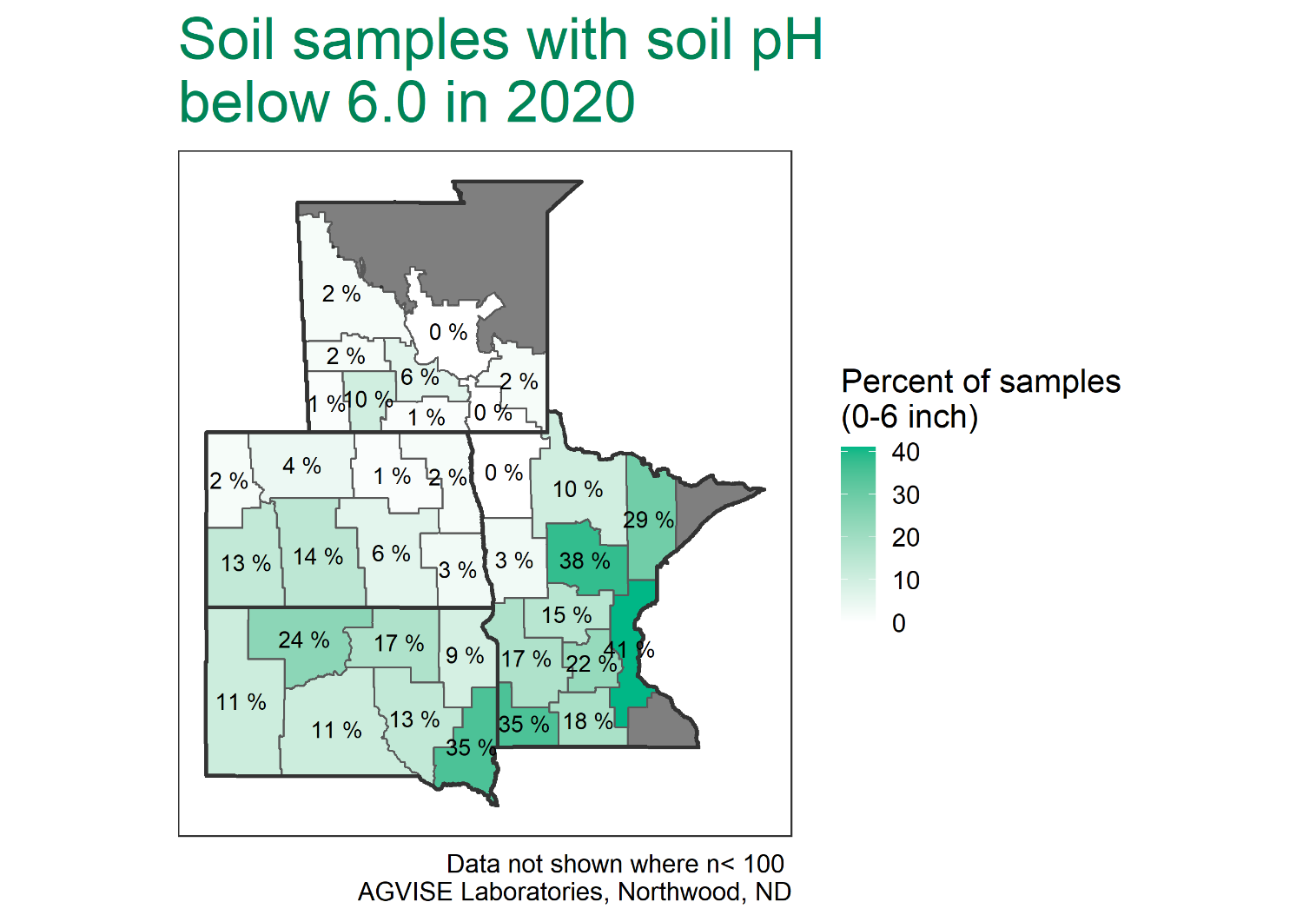
Potential calcium deficiencies are most common on sandy soils with strongly acidic pH (pH less than 5.0). Luckily, the fix for low soil pH also fixes potential Ca deficiencies. To correct soil pH, agricultural limestone is applied to raise soil pH to 6.0 or 6.5, if growing sensitive crops like alfalfa or clover. When limestone (calcium carbonate) is applied in tons per acre, more than enough calcium is also applied and sufficiently increases soil test Ca, providing ample calcium for optimal crop growth and development. Throughout the region, soils with low soil pH are more common in the higher rainfall areas to the east and south (Figure 2), and liming is a standard practice to correct soil pH and provide calcium.

Soil samples with soil pH below 6.0 in 2020, for 5 things you should know article

Figure 2. Soil samples with pH below 6.0 in 2020, where lime application may be required. The number of fields with low pH has increased over time and will continue to do so because soil acidification is a natural process. Keep watch for low soil pH, especially in western North Dakota and South Dakota. You can find more soil test summary data, including Montana and Canada, here.

2. Multiple calcium fertilizer sources exist; some increase pH, others do not

Agricultural limestone is the most common lime source and is available in two flavors: calcitic (calcium carbonate, <5% magnesium) or dolomitic (calcium-magnesium carbonate, >5% magnesium). Limestone quarries exist in southern Minnesota and Iowa, but the northern Great Plains is virtually devoid of mineable limestone. Industrial waste lime (spent lime) is another good lime source and available from sugar beet processing plants and water treatment plants throughout the region. Any of these liming materials will supply enough calcium to increase soil test Ca if soil pH is increased above pH 6.0.

Gypsum (calcium sulfate) is another calcium source, but it does not change soil pH. Gypsum is sometimes used to increase soil test Ca if the producer does not want to increase soil pH with lime application. This situation is common in irrigated potato production where increased soil pH may increase soil-borne diseases like common scab of potato. Gypsum is not a lime source, so it will not increase soil pH.

3. There is no “ideal” base cation saturation range or ratio for calcium

Suggestions that Ca and other base cations (magnesium, potassium) are required in a certain percentage or ratio in soil are not supported by modern science. Recent research done at several universities shows a wide range of base cation ratios in soil will support normal crop growth (see links below). What is important is that a sufficient soil test amount of each base cation (Ca Mg, K) is present in soil to support plant growth and development.

4. Soils with pH greater than 7.3 will have falsely inflated soil test Ca and cation exchange capacity (CEC) results

Soils with pH greater than 7.3 will contain some amount of naturally occurring calcium carbonate (CaCO3), shown on the soil test report as carbonate (CCE). The calcium soil test method will extract Ca on cation exchange sites and some Ca from calcium carbonate minerals, resulting in an inflated soil test Ca result. Starting with inflated soil test Ca, the routine cation exchange capacity (CEC) calculation is also inflated. For example, a soil with pH 7.8 and 3.0% CCE may report CEC at 60 meq/100 g, but the correct CEC is only 27 meq/100 g. To obtain accurate CEC results on soil with pH greater than 7.3, a special displacement CEC laboratory method is required. For soils with pH less than 7.3, the routine CEC calculation method will provide accurate soil test Ca and CEC results. High soil salinity (soluble salts, EC) can also inflate CEC results.

5. Calcium is not an environmental risk to surface or ground water

Calcium is one of the major dissolved substances found in surface and ground waters, especially in the northern Great Plains and Canadian Prairies. In fact, water hardness is determined from the amount of dissolved calcium and magnesium in water. There is already so much calcium found in natural waters in the region that calcium fertilizer additions to soil are negligible. Water hardness does affect the effectiveness of some herbicides and may cause tank-mixing issues, but is not an environmental concern.

Bonus: Just because your tomatoes have had blossom-end rot does NOT mean your soil is Ca deficient!

If you are a backyard tomato grower, you may have experienced blossom-end rot before, where the blossom-end of developing fruits turn brown and mushy while still on the plant. Yes, the problem is caused by low calcium in the tomato plant, but not necessarily because the soil has low soil test Ca. Blossom-end rot is primarily caused by inconsistent soil moisture. Adequate soil moisture is required to maintain a consistent supply of calcium moving to the plant root, which might run short if watering is inconsistent. To keep blossom-end rot away from your garden, just try to be more consistent with watering, especially during dry periods.

Resources on Base Cation Saturation Ratios

Cation Exchange: A Review, IPNI

Soil Cation Ratios for Crop Production, UMN

A Review of the Use of the Basic Cation Saturation Ratio and the “Ideal” Soil, SSSA Journal