

Soybean cyst nematode: Failing resistance traits, increasing SCN populations
Originally featured in the Winter 2020-2021 AGVISE Laboratories Newsletter
In 2019, AGVISE Laboratories investigated if popular soybean varieties with PI88788 or Peking SCN-resistance traits were effectively providing protection from soybean cyst nematode (SCN) and found that a number of the varieties failed to do so. We expanded the project in 2020 with cooperation from agronomists in west-central Minnesota.
For over 20 years, PI88788 has been the primary SCN-resistance trait in over 95% of soybean varieties. In the past few years, university research is showing that PI88788 is losing its effectiveness at controlling SCN. Detecting SCN-resistant trait failure with the naked eye is impossible, unlike the detection of failed pesticide control, where you can still see a herbicide-resistant weed that is growing vigorously. Therefore, we wanted to demonstrate how you can measure SCN resistance with soil sampling, even though you cannot see it with your naked eye.
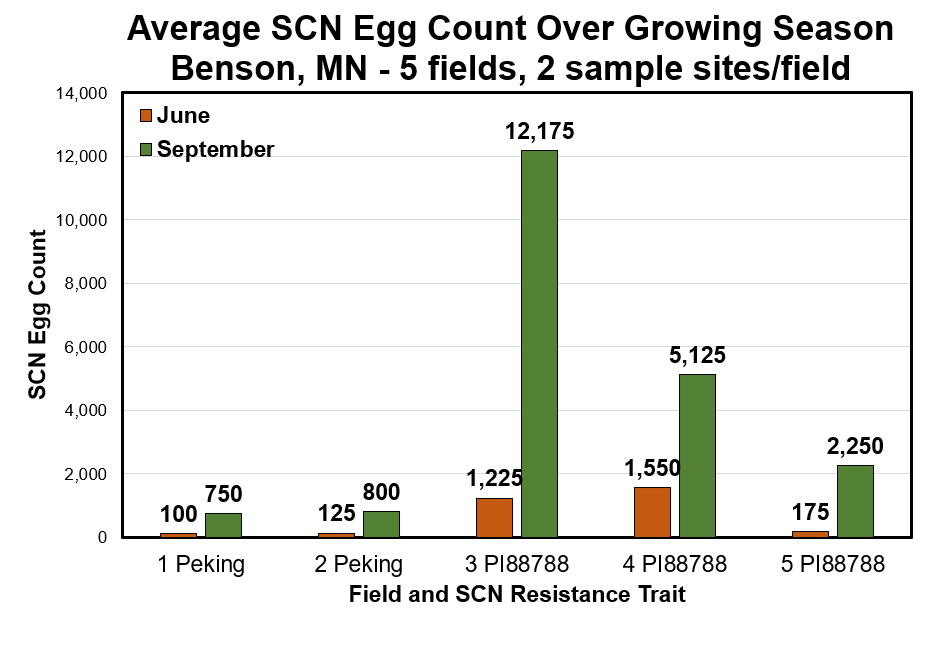 In the project, we had 41 soybean fields with SCN-resistant varieties, 35 with the PI88788 trait, and 6 with the Peking trait. In each field, a location was flagged and soil sampled for SCN egg count in early (June) and late (September) parts of the growing season. From June to September, the SCN egg count increased by 4.9 times on average across all 41 soybean fields (individual field reproduction factor ranged from 1.2 to 12.9). In some fields, the high SCN reproduction rate shows that SCN were successfully reproducing on soybean plants and the SCN resistance trait is failling. We also learned that soybean varieties with the Peking trait had much better control of SCN than those with the PI88788 trait. One cooperator from Benson, MN grew both PI88788 and Peking soybean varieties on his farm. He noted a 2.5 bu/acre soybean yield advantage with the Peking soybean variety (56.5 bu/acre) over the PI88788 soybean variety (54.0 bu/acre).
The project showed that SCN soil sampling in the early vs. late growing season was a simple way to detect a failing SCN resistance trait. The simple protocol only takes a big flag to mark the spot, then a set of soil samples in June and September to compare the SCN egg count results.