

• Shopping Cart Shopping Cart
    0Shopping Cart
Agvise Laboratories
  • Services
    • For Agriculture
    • For Lawn & Garden
    • For GLP Clients
    • AGVISOR Login
    • Pay Invoice Online
  • Resources
    • Forms & Guides
    • Agronomy Blog
    • Newsletter
    • Soil Test Summary
    • Seminars & Events
    • Precision Ag Helpers
    • Sign Up for Updates
  • Store
    • Hand Equipment
      • Soil Probe Handle
      • Soil Probe Tube
      • Accessories
    • Hydraulic Equipment
      • Soil Sampling System Kit
      • Power Unit
      • Soil Probe – Quicktach
      • Accessories
      • Replacement Parts
      • Wintex 1000
      • Used Equipment
    • Soil Grinding Equipment
      • Soil Grinding System
      • Replacement Parts
    • Supplies
      • Submission Forms
      • Bags and Containers
      • Shipping
      • Research Project Media
  • About Us
    • People
    • History
    • Certifications
  • Contact Us
    • Email
    • Locations
    • Employment
    • Update Contact Information
  • AGVISOR Login
  • Pay Invoice
  • Menu Menu
Blog
John Lee

Preparing for Spring Soil Sampling

March 19, 2021/in Equipment/by John Lee

Even when fall soil sampling weather cooperates, there is always some soil sampling to do each spring. No matter the spring conditions, the soil sampling window is tight if you are planning to collect soil samples and get the soil test results back in time for spring fertilizer decisions. You will want to pull soil samples before the field will carry a pickup truck, without leaving deep ruts, to maximize the spring soil sampling window. Your soil sampling rig choices are usually walking the field with a hand soil probe or using an ATV/UTV.

Over the years, many creative clients have outfitted UTVs with hydraulic soil sampling equipment to collect 24-inch soil cores in the spring. This has allowed soil samplers to get into a field about one week before it could carry a pickup truck. It is a big deal if you can get soil test results back one week sooner in the spring!
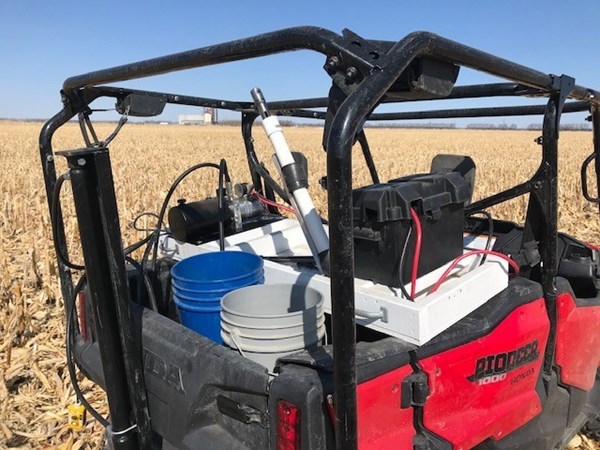
It is fairly simple to rig a UTV with the receiver hitch-mounted hydraulic soil sampling system kit. All you need to build is a wooden box to hold the electric-hydraulic power unit and a large starter battery. The hydraulic cylinder is mounted on a channel iron, which simply attaches to the receiver hitch. A large starter battery has enough charge to complete a good day of soil sampling without a recharge. Just make sure you put the battery on the charger overnight.

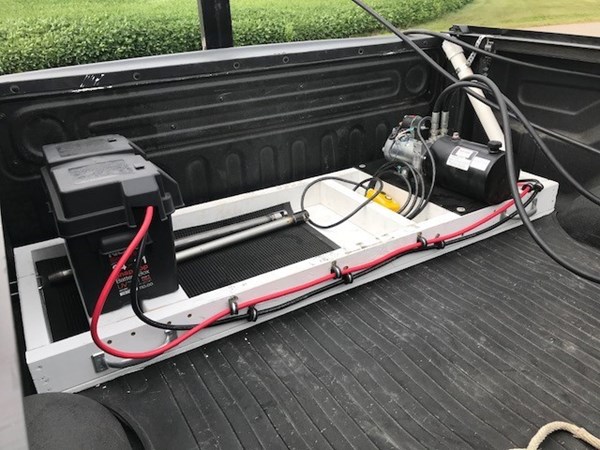
Some clients have created hydraulic soil sampling systems that can be quickly added and removed from a pickup truck box or UTV. It is a quick and easy add-on for the couple weeks of spring soil sampling that you may do. If you want some simple designs for self-contained soil sampling systems that can be removed in 10 minutes or less, these are some examples to consider.
 

Once the soil sample is collected, the next step in successful spring soil testing is getting them analyzed ASAP. AGVISE Laboratories knows that every spring soil sample is a rush, and our normal turnaround time is next-day (24 hours after soil sample is received). If you need any soil sampling equipment or supplies, we have everything in stock to ensure you get spring soil testing completed on time. We know spring soil testing can be stressful, but we hope to make it easier with the right soil sampling equipment and the reliable soil testing services that AGVISE has provided since 1976.

Share:
  • Share on Facebook
  • Share on X
  • Share on WhatsApp
  • Share on LinkedIn
  • Share by Mail
https://www.agvise.com/wp-content/uploads/2020/05/agvise_page_logo_png.png 0 0 John Lee https://www.agvise.com/wp-content/uploads/2020/05/agvise_page_logo_png.png John Lee2021-03-19 11:11:122023-04-19 14:54:00Preparing for Spring Soil Sampling

Article Categories

  • AGVISE Laboratories
    • Quality Control
    • Regional Data
    • Research
  • Crop Management
    • Canola
    • Corn
    • Cover Crop
    • Lawn and Garden
    • Potato
    • Prevented Planting
    • Soybean
    • Sugar Beet
    • Sunflower
    • Wheat
  • Environment
    • Drought
    • Water Quality
  • Fertilizer
    • Crop Removal
    • Fertilizer Placement
    • In-Season Fertilizer
    • Starter Fertilizer
  • Integrated Pest Management
    • Disease
    • Weed
  • Manure
  • Plant Analysis
    • Troubleshooting
  • Soil Analysis
    • Soil Biological Analysis
    • Soil Chemical Analysis
    • Soil Physical Analysis
  • Soil Fertility and Plant Nutrition
    • Base Cation Saturation Ratio
    • Calcium
    • Micronutrients
      • Copper
      • Iron
      • Molybdenum
      • Zinc
    • Nitrogen
    • Phosphorus
    • Potassium
    • Soil pH
    • Sulfur
  • Soil Health
  • Soil Management
    • Saline and Sodic Soil
    • Soil Amendment
    • Soil Erosion
    • Tillage
  • Soil Sampling
    • Equipment
    • Precision Ag

Northwood Laboratory

804 Hwy 15 West
P.O. Box 510
Northwood, ND 58267
Phone: 701-587-6010
Fax: 701-587-6013

Benson Laboratory

902 13th Street North
P.O. Box 187
Benson, MN 56215
Phone: 320-843-4109
Fax: 320-843-2074

Canada Shipping Address

380 Kimberly Road
Winkler, MB R6W 0H7
Phone: 701-587-6010


© Copyright - Agvise Laboratories Privacy Policy   Cookie Policy
  • Link to X
  • Link to LinkedIn
  • Link to Facebook
  • Link to Youtube
  • Home
  • Services
  • Resources
  • Store
  • About Us
  • Contact Us
Link to: Adjusting high soil pH and salinity with sugar beet-processing spent lime Link to: Adjusting high soil pH and salinity with sugar beet-processing spent lime Adjusting high soil pH and salinity with sugar beet-processing spent lime Link to: Starter Fertilizer: Choosing the Right Seed-Safe Rate Link to: Starter Fertilizer: Choosing the Right Seed-Safe Rate Starter Fertilizer: Choosing the Right Seed-Safe Rate
Scroll to top