
• Shopping Cart Shopping Cart
    0Shopping Cart
Agvise Laboratories
  • Services
    • For Agriculture
    • For Lawn & Garden
    • For GLP Clients
    • AGVISOR Login
    • Pay Invoice Online
  • Resources
    • Forms & Guides
    • Agronomy Blog
    • Newsletter
    • Soil Test Summary
    • Seminars & Events
    • Precision Ag Helpers
    • Sign Up for Updates
  • Store
    • Hand Equipment
      • Soil Probe Handle
      • Soil Probe Tube
      • Accessories
    • Hydraulic Equipment
      • Soil Sampling System Kit
      • Power Unit
      • Soil Probe – Quicktach
      • Accessories
      • Replacement Parts
      • Wintex 1000
      • Used Equipment
    • Soil Grinding Equipment
      • Soil Grinding System
      • Replacement Parts
    • Supplies
      • Submission Forms
      • Bags and Containers
      • Shipping
      • Research Project Media
  • About Us
    • People
    • History
    • Certifications
  • Contact Us
    • Email
    • Locations
    • Employment
    • Update Contact Information
  • AGVISOR Login
  • Pay Invoice
  • Menu Menu
Blog
Richard Jenny

Corn Stalk Nitrate Test

September 28, 2021/in Corn, Nitrogen, Plant Analysis/by Richard Jenny

To help evaluate nitrogen management in corn, you may want to try the corn stalk nitrate test as a post-mortem tool. The corn stalk nitrate test is a late-season or end-of-season plant analysis on mature corn stalks. Iowa State University developed the corn stalk sampling protocol and interpretation. If corn did not have sufficient nitrogen, the corn stalk nitrate level will be low. If corn had excess nitrogen, the corn stalk nitrate level will be high.

The corn stalk nitrate test can be useful in cropping systems with manure or corn-after-alfalfa, where a significant portion of the crop nitrogen budget comes from nitrogen mineralization. It is also helpful in more humid climates, where the residual soil nitrate-nitrogen test is not utilized. For corn silage production, it is easy to collect corn stalk samples on the go during silage harvest, making it a quick and useful tool.

Since the corn stalk nitrate test is a post-mortem tool with the goal to provide information for future years, it is not recommended in years with abnormal precipitation. In drought years, potential crop productivity is reduced, so the plant nitrogen requirement is lower than normal. In high precipitation years, soil nitrogen losses will reduce the available nitrogen supply. As a result, the corn stalk nitrate level can be very high in drought years or very low in wet years. Such results say more about environmental conditions, not the adequacy of the nitrogen fertilizer program.

When to sample

  • Early: One-quarter milk line (R5 growth stage) on majority of corn kernels. Nitrate concentration may be high if collected early.
  • Optimum: One to three weeks after physiological maturity (black layer, R6 growth stage) on 80% of corn kernels.
  • Late: Up to harvest. Nitrate concentration may be low if rainfall has leached nitrate from plant material.

How to sample

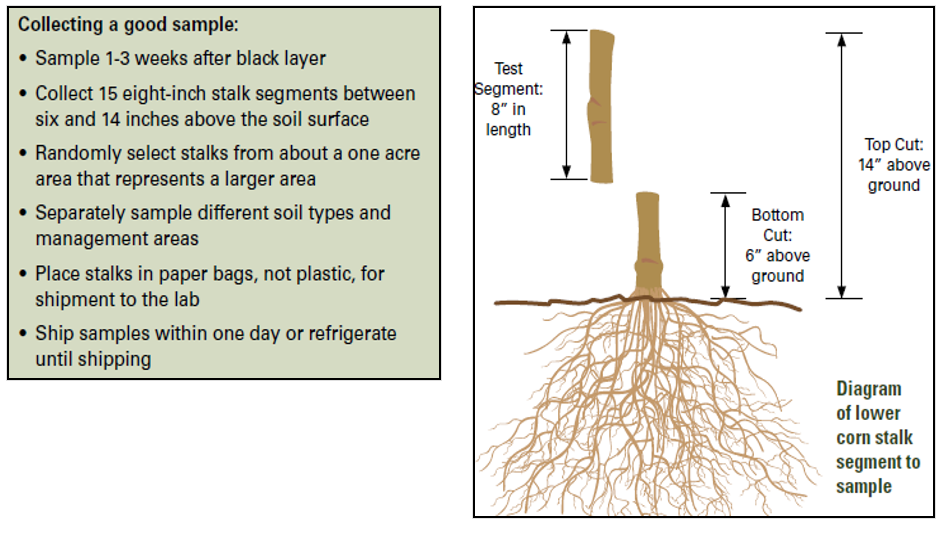
  • Measure 6 inches from the ground, cut the next 8 inches of corn stalk (the 6-14 inch stalk section measured from plant base). Remove outside leaf sheath.
  • Collect 12 to 15 corn stalks.
  • Place corn stalks in a ventilated plant tissue bag. Do not use plastic or zipped bag.
  • Do not collect diseased or damaged corn stalks.

Table 1. Corn Stalk Nitrate Test Interpretation

Nitrate-N (NO3-N), ppm Interpretation Comment
<250 Low Nitrogen supply was likely deficient and limited corn grain yield
250-2000 Sufficient
>2000 High Nitrogen supply exceeded plant requirement
for corn stalk nitrate test article

Corn stalk sampling instructions for end-of-season corn stalk nitrate test (from Iowa State Univ. Ext. Circ. CROP 3154, 2018).

Share:
  • Share on Facebook
  • Share on X
  • Share on WhatsApp
  • Share on LinkedIn
  • Share by Mail
https://www.agvise.com/wp-content/uploads/2020/05/agvise_page_logo_png.png 0 0 Richard Jenny https://www.agvise.com/wp-content/uploads/2020/05/agvise_page_logo_png.png Richard Jenny2021-09-28 09:00:512025-09-23 10:29:23Corn Stalk Nitrate Test

Article Categories

  • AGVISE Laboratories
    • Quality Control
    • Regional Data
    • Research
  • Crop Management
    • Canola
    • Corn
    • Cover Crop
    • Lawn and Garden
    • Potato
    • Prevented Planting
    • Soybean
    • Sugar Beet
    • Sunflower
    • Wheat
  • Environment
    • Drought
    • Water Quality
  • Fertilizer
    • Crop Removal
    • Fertilizer Placement
    • In-Season Fertilizer
    • Starter Fertilizer
  • Integrated Pest Management
    • Disease
    • Weed
  • Manure
  • Plant Analysis
    • Troubleshooting
  • Soil Analysis
    • Soil Biological Analysis
    • Soil Chemical Analysis
    • Soil Physical Analysis
  • Soil Fertility and Plant Nutrition
    • Base Cation Saturation Ratio
    • Calcium
    • Micronutrients
      • Copper
      • Iron
      • Molybdenum
      • Zinc
    • Nitrogen
    • Phosphorus
    • Potassium
    • Soil pH
    • Sulfur
  • Soil Health
  • Soil Management
    • Saline and Sodic Soil
    • Soil Amendment
    • Soil Erosion
    • Tillage
  • Soil Sampling
    • Equipment
    • Precision Ag

Northwood Laboratory

804 Hwy 15 West
P.O. Box 510
Northwood, ND 58267
Phone: 701-587-6010
Fax: 701-587-6013

Benson Laboratory

902 13th Street North
P.O. Box 187
Benson, MN 56215
Phone: 320-843-4109
Fax: 320-843-2074

Canada Shipping Address

380 Kimberly Road
Winkler, MB R6W 0H7
Phone: 701-587-6010


© Copyright - Agvise Laboratories Privacy Policy   Cookie Policy
  • Link to X
  • Link to LinkedIn
  • Link to Facebook
  • Link to Youtube
  • Home
  • Services
  • Resources
  • Store
  • About Us
  • Contact Us
Link to: Soil Nitrogen Trends – Fall 2021; High Variability Following Drought Link to: Soil Nitrogen Trends – Fall 2021; High Variability Following Drought Soil Nitrogen Trends – Fall 2021; High Variability Following Drought Link to: Soil Sample Before Tillage: Consistent sample depth matters! Link to: Soil Sample Before Tillage: Consistent sample depth matters! Soil Sample Before Tillage: Consistent sample depth matters!
Scroll to top