

• Shopping Cart Shopping Cart
    0Shopping Cart
Agvise Laboratories
  • Services
    • For Agriculture
    • For Lawn & Garden
    • For GLP Clients
    • AGVISOR Login
    • Pay Invoice Online
  • Resources
    • Forms & Guides
    • Agronomy Blog
    • Newsletter
    • Soil Test Summary
    • Seminars & Events
    • Precision Ag Helpers
    • Sign Up for Updates
  • Store
    • Hand Equipment
      • Soil Probe Handle
      • Soil Probe Tube
      • Accessories
    • Hydraulic Equipment
      • Soil Sampling System Kit
      • Power Unit
      • Soil Probe – Quicktach
      • Accessories
      • Replacement Parts
      • Wintex 1000
      • Used Equipment
    • Soil Grinding Equipment
      • Soil Grinding System
      • Replacement Parts
    • Supplies
      • Submission Forms
      • Bags and Containers
      • Shipping
      • Research Project Media
  • About Us
    • People
    • History
    • Certifications
  • Contact Us
    • Email
    • Locations
    • Employment
    • Update Contact Information
  • AGVISOR Login
  • Pay Invoice
  • Menu Menu
Blog
John Lee

2021 Drought: High residual soil nitrate-nitrogen across the region

November 30, 2021/in Corn, Drought, Nitrogen, Regional Data, Wheat/by John Lee

This article originally appeared in the AGVISE Laboratories Winter 2022 Newsletter.

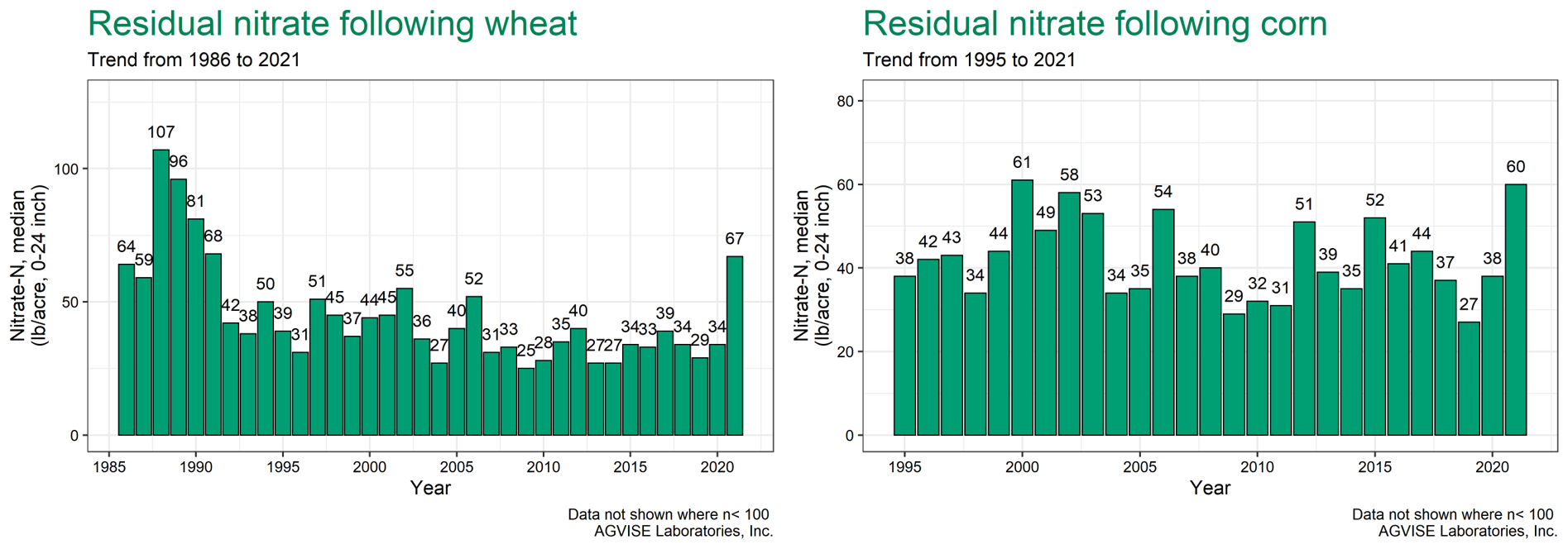
The 2021 drought rivals the 1988 drought, and it covered much of the northern Great Plains and Canadian Prairies. From previous experience with droughts, we expected that residual soil nitrate-N following crops would be higher than normal, caused by the drought and reduced crop yields. The first wheat fields that were soil tested in August and September confirmed our expectation that residual soil nitrate-N was already trending much higher than normal.

The 2021 AGVISE soil test summary data highlights how exceptional the 2021 drought was. The median amount of soil nitrate-N across the region was markedly higher following wheat and corn. Over 20% of wheat fields had more than 100 lb/acre nitrate-N (0-24 inch) remaining, and another 40% of wheat fields had a sizable 40 to 80 lb/acre nitrate-N (0-24 inch) left over. For any given farm, the great variability in residual soil nitrate-N makes choosing one single nitrogen fertilizer rates impossible, and soil testing is the only way to decide that right rate for each field.

Through zone soil sampling, we were also able to identify that residual soil nitrate-N varied considerably within a field. This makes sense because we know that some areas of the field produced a fair yield, leaving behind less soil nitrate, while other areas produced very poorly and left behind much more soil nitrate. These differences across the landscape are driven by soil texture, soil organic matter, and stored soil water as well as specific problems like soil salinity or low soil pH (aluminum toxicity). Although the regional residual soil nitrate-N trends were higher overall, it is truly through zone soil sampling that we can begin to make sense of the field variability that drives crop productivity and the right fertilizer rate for next year.

For fields that have not been soil tested yet, there is still time to collect soil samples in winter (see winter soil sampling article). Nobody wants to experience another drought, but this kind of weather reminds us how important soil nitrate testing is every year for producers in the Great Plains. Each year, AGVISE summarizes soil test data for soil nutrients and properties in our major trade region of the United States and Canada. For more soil test summary data and other crops, please take a look at our soil test summaries online.



Share:
  • Share on Facebook
  • Share on X
  • Share on WhatsApp
  • Share on LinkedIn
  • Share by Mail
https://www.agvise.com/wp-content/uploads/2020/05/agvise_page_logo_png.png 0 0 John Lee https://www.agvise.com/wp-content/uploads/2020/05/agvise_page_logo_png.png John Lee2021-11-30 10:00:402025-09-23 10:35:312021 Drought: High residual soil nitrate-nitrogen across the region

Article Categories

  • AGVISE Laboratories
    • Quality Control
    • Regional Data
    • Research
  • Crop Management
    • Canola
    • Corn
    • Cover Crop
    • Lawn and Garden
    • Potato
    • Prevented Planting
    • Soybean
    • Sugar Beet
    • Sunflower
    • Wheat
  • Environment
    • Drought
    • Water Quality
  • Fertilizer
    • Crop Removal
    • Fertilizer Placement
    • In-Season Fertilizer
    • Starter Fertilizer
  • Integrated Pest Management
    • Disease
    • Weed
  • Manure
  • Plant Analysis
    • Troubleshooting
  • Soil Analysis
    • Soil Biological Analysis
    • Soil Chemical Analysis
    • Soil Physical Analysis
  • Soil Fertility and Plant Nutrition
    • Base Cation Saturation Ratio
    • Calcium
    • Micronutrients
      • Copper
      • Iron
      • Molybdenum
      • Zinc
    • Nitrogen
    • Phosphorus
    • Potassium
    • Soil pH
    • Sulfur
  • Soil Health
  • Soil Management
    • Saline and Sodic Soil
    • Soil Amendment
    • Soil Erosion
    • Tillage
  • Soil Sampling
    • Equipment
    • Precision Ag

Northwood Laboratory

804 Hwy 15 West
P.O. Box 510
Northwood, ND 58267
Phone: 701-587-6010
Fax: 701-587-6013

Benson Laboratory

902 13th Street North
P.O. Box 187
Benson, MN 56215
Phone: 320-843-4109
Fax: 320-843-2074

Canada Shipping Address

380 Kimberly Road
Winkler, MB R6W 0H7
Phone: 701-587-6010


© Copyright - Agvise Laboratories Privacy Policy   Cookie Policy
  • Link to X
  • Link to LinkedIn
  • Link to Facebook
  • Link to Youtube
  • Home
  • Services
  • Resources
  • Store
  • About Us
  • Contact Us
Link to: Banding Phosphorus and Potassium: Stretch your fertilizer dollars further Link to: Banding Phosphorus and Potassium: Stretch your fertilizer dollars further Banding Phosphorus and Potassium: Stretch your fertilizer dollars further Link to: Zone Soil Sampling and Variable Rate Fertilization: Optimizing profits Link to: Zone Soil Sampling and Variable Rate Fertilization: Optimizing profits Zone Soil Sampling and Variable Rate Fertilization: Optimizing profits
Scroll to top